For material handling veterans, it feels like only yesterday when robotic systems achieved widespread, mainstream adoption in warehouses and distribution centers. Today, a wide array of solutions, from increasingly flexible and fast pickers to palletizing and depalletizing systems and automated mobile robots, are proven to deliver exceptional reliability, throughput and order accuracy. In warehouses where the ability to flawlessly process millions of items is crucial, robotic systems are now the norm.
There is no denying that robots are increasingly the hallmark of high-performance warehouses, fulfillment and supply systems. And unlike their legacy predecessors, robots that thrived doing high-frequency, low variability tasks – jobs that are still ideally suited for automation – today’s systems are far more flexible and adept at tasks only people could do just a few years ago.
Innovations in robotics, from end effectors that are able to process a variety of product categories and package types, to advancements in vision capabilities that enable deployments in varied settings, upended what is possible. Simultaneously, artificial intelligence (AI) and its unprecedented orchestration capabilities emerged to make robots applicable for an ever-growing array of use cases.
Understandably, such advancements were often – and rightfully – met with more than a little hype, a tradition that continues. But unlike years past, when the flash and excitement associated with point solutions and new humanoid-like robots grabbed everyone’s attention, warehouse and distribution center professionals today are far more circumspect. Robotics, like all forms of automation, is now correctly considered a required asset.
And just as importantly, warehouse leaders continue to look to robotics for the very same reasons that first drew materials handling teams to automation. The shortage of labor remains endemic, even as the pressure to achieve ever higher throughput, storage capacity, absolute order accuracy and maximum uptime remains.
Like all investments to address these longstanding challenges, the use and deployment of robotic assets must not only address real-world imperatives, but also perform as expected when deployed. It is within these real-world deployments that several key trends in robotics are taking shape – trends that warehouse leaders should evaluate no matter where they are on their automation journey, whether broadly or in robotics specifically.
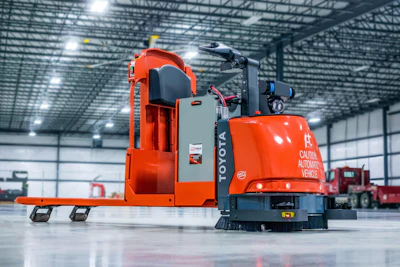
● The use of robots is no longer confined to the most advanced distribution centers. One of the most noteworthy developments shaping the warehousing arena today is that robots are applicable not just in the most advanced facilities, but across the materials handling landscape. This includes the application of robotics in facilities that have just begun to automate longstanding manual processes, where the use of automated mobile robots (AMRs) – often deployed as a service in which they are rented and deployed quickly as demand changes or peak seasons occur – represents one of the easiest ways to augment existing teams with automation to increase efficiency. In AMRs, we are seeing the democratization of robotics across supply chains.
● The notion of what comprises a robot has evolved beyond humanoid-like, standalone machines. In the past, the very notion of what comprised a robot typically centered on a distinct machine. With the mainstream adoption of robotics, warehousing teams increasingly appreciate that robots rarely work in isolation. Instead, to achieve their full potential they must be integrated across operations end-to-end, increasingly in the form of AI-enabled systems that facilitate the successful completion of distinct tasks. This is particularly important in light of the next two trends that follow.
● Software has emerged as a key driver of robotic capabilities. As the selection and variety of robots proven in the most demanding warehouses and distribution centers increases, the software on which they depend is now a key differentiator, and with good reason. Encompassing everything from vision capabilities – now table stakes in AMRs and applications like picking – to supervisory command and control, and predictive maintenance – software is now where some of the most impressive innovation occurs.
Notably, the hallmarks of great software still reign supreme, among them resiliency, intuitive user interfaces, inherent data protection and security, and of course features and functionality that not only enable materials handling operations to select the ideal robot for their unique needs, but to configure their application for maximum performance and utility. In short, the software on which robotic systems run is just as important as the robots themselves.
● Warehouses are shifting to integrated, holistic systems. The speed, order accuracy and even the flexibility of today’s robotic systems are a direct reflection not just of innovations in robotics, but just as importantly, the growing use of, and demand for, fully integrated warehouse systems. While the need for integrated systems in fulfillment and supply facilities is not new, the depth of the integration in today’s most advanced, high-performance warehouse systems is more extensive than ever.
This integration extends across a broad technology ecosystem, from website and e-commerce order applications to warehouse management systems, enterprise resource planning platforms, parcel and freight solutions, and other business-specific systems. Together, these platforms provide operational and financial leaders with the data and intelligence needed to make sound decisions. Within the warehouse itself, however, the number of machines, systems, and robotic assets that must connect and exchange data in real time has never been greater. As a result, robotics solutions that are easily integrated, interoperable, or technology agnostic are emerging as the strongest performers. At the same time, third-party partners with deep domain expertise and a clear understanding of the expanding range of available technologies are becoming more important than ever.
● Rigorous analysis and "pressure-testing" are now non-negotiable precursors to any robotics implementation. Recent high-profile failures of large-scale warehouse automation programs have reinforced a long-standing lesson: successful implementations require far more than promising technology. Before any major automation initiative begins, including those involving robotic systems, materials handling operations need a detailed business case, rigorous analysis of foundational data, thorough pressure-testing, and pilot programs that validate performance in real-world conditions.
That evaluation should extend beyond core metrics such as sales volumes, expected return on investment, labor savings, and other projected gains. It must also examine the underlying processes being automated or performed by robots. This is where advanced tools like AI-driven Digital Twins become invaluable, allowing companies to simulate, pressure-test, and validate complex automation processes in a virtual environment long before real-world implementation begins. After all, automating a flawed process does not fix it; it simply allows the wrong work to happen faster.
● While increasingly integrated, robotics and AI remain distinct disciplines. The application of AI for robotics and other warehouse and distribution use cases must be carefully considered and thoroughly vetted. Ideally, warehouse leaders vet the many AI solutions available only after it is first determined that AI represents the most compelling solution to the warehouse challenges they seek to solve – not because of generic “AI modernization” efforts. Like all automation and robotic implementations, warehouse AI implementations should occur only after successful pilot programs after the completion of a comprehensive business case.
By keeping these considerations in mind, leaders are well-positioned to benefit from the golden age of robotics. Just as importantly, the innovations now taking shape promise to raise the bar for supply chains as a whole, as customers, consumers and warehouse employees benefit from the performance and safety that today’s robotic systems deliver.