Demand is growing throughout the cold chain to integrate purchase order (PO) information with data generated by condition-logging and real-time tracking devices. Larger end users are the most influential stakeholders driving this trend. But many small- and medium-sized companies also see opportunities to improve processes and reduce labor costs by integrating the POs they issue to their vendors and shipment-monitoring platforms.
Pending legislation is another key factor. Although Food Safety Modernization Act (FSMA) 204 regulations mandating temperature records to match their corresponding lot codes has been delayed, they are expected to be implemented. This legislation is already starting to add further momentum to calls for integration, and the urgency will increase as they become closer to reality as many end users are using the PO number as a bridge to match temperature records to their lot code. Despite years of advance warning, however, many food suppliers and end users are not yet ready for the changes FSMA 204 will bring; those that prepare for these requirements now are more likely to ensure a smooth transition.
Here’s the challenges currently facing cold chain stakeholders and how data integration can help them thrive.
Suppliers using logging devices
End user requests or requirements for suppliers to use temperature loggers on inbound shipments to their facilities are on the rise. They’re also increasingly asking vendors to match the logger’s serial number to the PO number associated with the load.
Many vendors struggle to do this because they’re using one internal system to organize their data and another to set up the devices. This might be a transportation management system (TMS), enterprise resource planning (ERP) system, warehouse management system (WMS), or in some cases a system they’ve built in-house. Entering the PO number into both systems duplicates effort, takes more time and increases the risk of errors.
A more elegant solution is to add a column or line item for the logger’s serial number into their existing system. A good device supplier will be willing to work with the software provider to accomplish this. The result is a streamlined data-entry process that allows the supplier to enter the PO number and logger serial number directly into their system at the same time. The data required by the device provider is transmitted automatically, enabling the supplier to remain in compliance with less effort.
Suppliers using real-time trackers
Vendors who use tracking devices instead of (or in addition to) loggers face similar challenges when complying with end user temperature monitoring programs. They can also benefit from a similar integration solution. But the process is slightly more complex because there are more fields applicable to real time temperature trackers.
When loggers are used, the only information that typically needs to be integrated is the PO number, the logger’s serial number and the receiver or customer. Sometimes, there are additional line items like the name of a foodservice company or the third-party logistics (3PL) company handling the load. The precise receiving location may also need to be specified if you’re shipping to a large retailer that operates under multiple banners, but the process is still fairly simple.
Trackers, on the other hand, require additional data like the origin and destination addresses, plus acceptable high and low temperatures for the load. As a result, manually creating POs in the device provider’s platform requires more labor for trackers than loggers.
For example, it usually takes about 10-20 seconds to manually create a PO for a wireless logger. Setting up the same PO for real-time trackers can regularly take between 30-60 seconds. That may not sound like a lot. But when you add up the labor hours needed to process loads at scale, it involves a decent chunk of time and can incur considerable costs to the overall system.
Thus, if your organizational software can be configured to add the device’s serial number and integrate with the tracking platform, you can eliminate unnecessary steps, reduce human errors, and save considerable time and labor costs. For suppliers using trackers and/or loggers, the business case for integration becomes more compelling as they ship more loads.
Receivers using logging devices
When a shipment equipped with a temperature logger arrives without the supplier interfacing with the device, the receiver may not necessarily know which PO it’s associated with. The most efficient way around this is to “bridge” the data from the shipper.
If the shipper has matched the PO number to the logger, the receiver can use the PO number to match it to its corresponding products lot numbers. This allows the a receivers software to create a bridge — a secure digital connection between the device supplier and the receiver — which can be used to match the data collected by the logger to the PO in the receiver’s system, along with other data such as the purchase price, case numbers and lot numbers.
This information will become increasingly more important as FSMA 204 regulations come into effect. The Food and Drug Administration (FDA) is specifically looking for ways to trace individual lot codes. But how do you do that if you just have a PO number?
If you’re able to pull temperature records from the logging device platform, you can hypothetically embed them into the lots. Many supermarkets, restaurants and other retailers are already working toward this goal. Although this is not yet mandated by the FDA, it may to be reality in the near future. Integration provides a clear and easy way to do that in real time, with the same software receivers are using today.
Receivers using real-time trackers
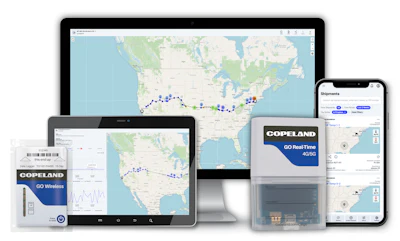
When real-time trackers are purchased by food suppliers, the units are assigned to the purchaser’s website. In many cases, however, the receiver who mandates the use of the device may want the data it collects, including any alerts triggered in transit. Receivers are also likely to want tracking data for all their suppliers to be accessible from a single platform. Although integration isn’t required to achieve this, it can make the process more efficient.
The most popular integration strategy is known as “dual visibility push” or “Share With.” In this scenario, the supplier uploads the tracker and load information and indicates which customer or receiving location it should be shared with. A copy of that tracker’s data is then pushed to the receiver’s internal website, which can receive similar data from every supplier that supports this capability.
A less common alternative is “dual visibility pull” or “Copy From.” This option allows the receiver to directly connect to the shipper’s system and securely “pull” data about shipments associated with them. Creating this link requires the approval of the shipper. Once established, the receiver gains access to shipment data using the serial number of the tracking device, which is attached to the bill of lading when the shipment is sent.
Dual visibility pull is a good option when shippers and receivers each want to create their own unique alerts. For example, a shipper may be satisfied if the load’s temperature is between 33-38°F, while the shipper may want an alert if it gets too close to the high end of that range. Pull is also useful for smaller retail operations working with suppliers who aren’t willing to go to the effort needed to push shipment data out to them.
The case for integration is clear
Thousands of suppliers and receivers rely on shipment trackers and loggers today, including growers, food producers, supermarkets, restaurants and other retailers.
Nearly all these stakeholders could be benefiting in some way by integrating PO and shipment monitoring data. In addition to the cost and labor savings, eliminating duplicate manual entry reduces the chance for errors or conflicting data. Integration can further empower every stage of the cold chain by providing greater visibility into specific POs when using real-time trackers, as well as making it easier to match POs to lot codes and temperature data.
This capability will become increasingly more important as the rollout of FSMA 204 approaches. Despite delays, matching POs to lot codes and temperature graphs will eventually be required. Preparing for these changes sooner rather than later will be best for any organization.
Integration isn’t just a benefit for suppliers who want to comply with their customers’ mandates. It can speed shipment creation for suppliers who use trackers for their own information. It limits the need for multiple platforms for suppliers to receive alerts and respond to potential problems. Retailers can also use it to accelerate and improve processes by collecting all their critical information in one clean space.