The supply chain industry faces a critical paradox: the relentless pressure to increase throughput and decrease costs means we are squeezing more assets, more manual forklifts, more AMRs, and more people, into the same facility footprints. This drive for density and speed, while essential for meeting consumer demand, creates a major safeguarding challenge that traditional safety measures can no longer meet.
The safeguarding focus is rapidly shifting from addressing isolated threats to managing the complex, unpredictable interactions in these mixed-fleet environments. Success now depends on leveraging advanced technology, particularly spatial AI, to move safety from being a reactive measure to a proactive driver of efficiency.
The failure of basic collision avoidance
Workforce safety, specifically around material handling equipment, is the top priority for any warehouse executive. Forklift-related accidents remain tragically common, emphasizing the need for better collaborative solutions.
Traditional anti-collision systems often fall short because they create a major problem: false positives. Basic systems, such as ultrasonic, simple LiDAR, recognize that an object is present, but lack the context to know what it is or where it is going. When a driver is constantly alerted while just driving past a person on a designated walkway, they become frustrated and frequently turn the system off, eliminating the safety barrier.
The solution isn't more sensors; it's more intelligence.
Spatial AI: Where am I and what’s around me?
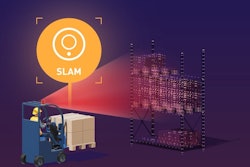
This is where spatial AI becomes a necessity, answering two critical questions in real-time: "where is the machine?" and "what is around it?"
Achieved with an intelligent camera constantly scanning forwards and backwards, spatial AI enables the advanced capabilities of real-time locating systems (RTLS).
Enhancing safety and uptime across mixed fleets
Most modern facilities run a complex mixed fleet of manual forklifts and autonomous vehicles (AMRs). Safety cannot be siloed; it must be universal. Spatial technology enhances safety across this entire environment by:
- Vehicle-to-robot communication: Manual vehicles become tracked, smart assets. This real-time spatial information, which included location, speed, and direction, is continuously shared with the AMRs. This allows robots, when planning their paths, to have visibility of potential threats, such as a fast-moving forklift around a blind corner. and proactively adjust their route to minimize the time the two vehicles are in the same space.
- Mitigating frustration: By making AMRs aware of manual vehicle traffic, they can navigate more efficiently and avoid causing traffic jams. This prevents drivers from getting frustrated and attempting dangerous overtakes, thereby minimizing the risk of a crash.
Proactive validation with digital twins
Digital twins allow clients to proactively simulate, test, and validate new safety protocols such as new robot routes, high-risk intersection designs, or changes to workflow, before deploying them on the live floor. This capability ensures that the pursuit of increased throughput and speed is never achieved at the expense of safety.
The biggest human safeguarding challenge that can be effectively solved by better spatial AI is driver distraction and false complacency. By ensuring drivers are only alerted to genuine dangers, operators keep safety at the forefront without sacrificing the throughput needed to succeed in the high-density supply chain of today and tomorrow.