For the food and beverage industry, the shift away from single-use corrugate began years ago. So why is so much cardboard still piling up behind convenience stores, grocers, and small markets across the country?
The answer is simple, if not always easy to see. When you measure the cost of corrugate at the point of purchase, it looks like a huge cost saver. But when you measure its cost across the full lifecycle of your operation and compare it to the valuable returns of reusable packaging, you get a very different picture.
The food and beverage businesses that have already switched to reusable packaging all have one thing in common. They made an operational decision, not a procurement choice. In some cases, their customers demanded it. In others, advanced automation systems required it. For some, food safety obligations made the decision for them. All those businesses made their packaging decisions long before the spec ever landed on procurement’s desk.
But for operations still running on corrugate, the math is worth unpacking. Because those are the same operations still comparing the per-unit cost of a cardboard box to the upfront investment in a reusable tote. That calculation isn’t wrong. It’s just incomplete.
Because when you look across the operational lifecycle, tracing both single-use and reusable packaging from purchase to end-of-life, the true cost of corrugate is revealed across every stage of your operation.
Stage 1: Procurement
The true cost of corrugate starts accumulating long before your containers ever touch a conveyor. It appears in your monthly budget, where it’s reordered and expensed continuously. That cost can vary unpredictably, exposing your operation to price volatility and supply chain disruptions.
With reusable containers, on the other hand, the procurement decision is a controlled capital expense, not a volatile recurring cost. The reorder cycle becomes a fleet management exercise as the value of each reusable container compounds, and supply certainty replaces operational risk.
Stage 2: Storage and setup
Once you’ve purchased all that cardboard, you’ve got to put it somewhere. That might mean entire trailer loads standing by to help you manage supply chain disruptions. All that valuable floor space is freed up when you make the switch to a managed fleet of containers that cycle continuously through your distribution network.
Reusable containers also arrive at your facility ready to use. Single-use corrugate arrives stacked and bundled. Each container must be unpacked and built every time it enters your distribution facility. Erecting, taping, and staging all of those flat-packed containers is a labor cost that never shows up on your budget as a packaging expense, but it is. And it adds up fast.
Stage 3: Loading and pallet building
For convenience stores, pharmacies, and other small-format destinations, split-case picking is an operational reality. DCs pull partial quantities of slow-moving SKUs, such as candy, beverages, prepared foods, etc. These products are packed into outbound containers and delivered to stores with extremely limited storage capacity.
This is where structural liabilities and product protection enter the equation. Corrugate containers assembled by hand are structurally inconsistent from the start. Add in the fact that partially filled boxes lose stacking strength and, as mixed pallets are built by the loading dock door, that inconsistency becomes a problem. Hidden liquid spills can compromise corrugate integrity before the pallet even leaves the building, introducing cross-contamination risks for foodservice operations that extend beyond breakage and structural failure.
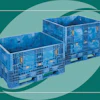
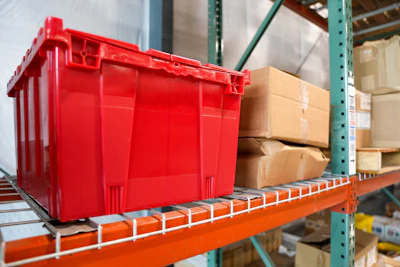
A well-engineered reusable tote, on the other hand, maintains structural integrity regardless of fill level. It also provides a consistent footprint and stack height, helping to stabilize and protect the pallet’s contents before they hit the open road.
Stage 4: Transit and delivery
Once the pallet leaves your dock, there’s another host of variables to consider. Sudden stops, sharp turns, bridge transitions… There’s a long list of forces that can cause the load to shift. When it does, corrugated packaging absorbs every hit, and container integrity degrades with each impact.
When it comes to prepared foods, those impacts introduce additional liability. If your container absorbs moisture, collects debris, or is compromised in transit, it can pose a significant food safety risk.
Not to mention that when a product arrives at the store damaged, it triggers a time-consuming credit and reorder process with its own administrative costs. And while those costs might get traced back to a packaging failure, they’re rarely factored into the overall packaging cost.
Reusable totes offer a level of product protection that single-use corrugated simply can’t. They’re engineered to deliver structural integrity and impact resistance throughout every stage of your distribution cycle.
 Monoflo International
Stage 5: In-store handling
The corrugated containers that arrive at the store also bring their own labor costs along for the ride. Breaking down boxes, baling, and managing disposal are all overhead expenses that the distribution center never sees. Instead, they land on the store’s operational budget, completely disconnected from the packaging purchase decision. But that’s just the start of the store-level costs.
In food service environments, cleanliness is non-negotiable. Corrugate dust and debris present a real, tangible liability here, potentially contaminating prepared foods. Corrugate also provides easy access for rodent and insect infiltration that rigid plastic containers prevent.
Reusable totes, in contrast, are clean and secure. They complete their delivery and re-enter the distribution cycle. No breakdown labor, no disposal costs, and no debris. The container becomes an operational asset rather than a potential liability.
Stage 6: End of the line
As you near the end of the container distribution cycle, the case for reusable containers vs. single-use corrugate should be coming into focus.
Corrugate packaging’s end-of-life costs recur constantly. Reusable containers, on the other hand, are designed to handle 300-plus cycles over a service life of 5-6 years. And when it’s time to retire your fleet, they can be pelletized and reprocessed, creating a closed-loop manufacturing chain. In the long run, that means less waste, fewer resources consumed, and more cost savings per delivery.
 Monoflo International
Time to reframe your packaging purchase
The true cost (and value) of your packaging isn’t captured in the purchase price. It’s only visible when you pull back and look at the full lifecycle of each container. At the hidden labor that shows up as a payroll expense… The damage that disappears into operating budgets… The recurring disposal costs that become delivery location overhead… Add it all up, and the budget impact of single-use packaging is impossible to ignore.
The food and beverage operations that have switched from corrugated to reusable containers knew what their purchasing departments couldn’t see. They heard it from their customers, their food safety advisors, their warehouse automation integrators. They understood that packaging decisions impact their entire business, not just the monthly budget.
For the operations still running on corrugate, the procurement math is more apparent than ever. But, more importantly, it’s clear the time has come to stop treating packaging as a purchasing choice and start treating it as an operational necessity.