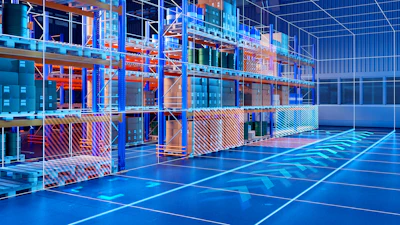
For decades, warehouse technology was designed around the single objective of execution efficiency. Warehouse management systems optimized inventory movements, labor allocation, and fulfillment workflows inside relatively stable operating environments where disruptions were manageable exceptions. However, that operating model no longer reflects reality.
Modern supply chains now function as highly interconnected ecosystems shaped by volatile demand, labor shortages, geopolitical instability, transportation disruption, and rapidly expanding automation. Warehouses are no longer isolated execution centers, but have become dynamic coordination hubs where human workers, robotics, AI systems, transportation networks, and inventory flows must continuously adapt in real-time.
This shift is fundamentally changing the role of supply chain technology. Competitive advantage is no longer determined only by how efficiently a warehouse executes pre-defined workflows. Increasingly, it depends on how intelligently operations can orchestrate resources, adapt decisions, and rebalance workflows in real time as conditions change.
As a result, organizations are moving away from rigid monolithic systems toward modular, AI-driven operational platforms designed for adaptability, resilience, and continuous optimization.
Warehouse management to warehouse orchestration
The most significant shift occurring inside warehousing today is the transition from management to orchestration. Traditional warehouse management systems focused primarily on execution functions such as inventory tracking, order allocation, labor management, and picking optimization. Those capabilities remain foundational, but modern warehouse environments now involve far more complexity.
Many facilities operate with combinations of autonomous mobile robots, goods-to-person systems, AI-driven planning tools, IoT sensors, automated storage systems, transportation platforms, and human workers functioning simultaneously inside shared workflows. The challenge is continuously coordinating how all of these systems interact, adapt, and respond together in real-time.
Warehouse orchestration introduces a far more dynamic operational model. Instead of executing static workflows, orchestration environments continuously evaluate warehouse conditions and rebalance operational activity based on live constraints, priorities, and capacity conditions across the facility.
If robotic throughput slows during peak demand, workflows can actively shift toward human operators. If inbound transportation delays create inventory shortages, fulfillment priorities can automatically rebalance to protect service levels. If labor availability changes unexpectedly, tasks can redistribute across automation and workforce resources without disrupting broader operations. This represents a fundamental structural change in warehouse operations.
Warehouses are no longer linear environments executing predefined processes. They are becoming adaptive ecosystems that continuously coordinate people, automation, inventory, and transportation simultaneously. That operational flexibility is becoming increasingly important as organizations prioritize resilience alongside efficiency.
Modular operational platforms support continuous adaptation
Historically, many warehouse environments relied on large centralized platforms that attempted to manage inventory, fulfillment, labor, and transportation coordination within tightly coupled system architectures. While these environments provided standardization, they often limited agility. Operational changes frequently required large-scale upgrades, long deployment cycles, or extensive integration work that slowed responsiveness.
Modern warehouse environments increasingly require a different level of flexibility. Modular operational platforms allow organizations to introduce capabilities incrementally while adapting workflows as business requirements evolve. Rather than forcing every operational process through a single rigid system structure, organizations can build more adaptive environments that integrate automation technologies, AI applications, labor systems, and operational data layers more fluidly.
This flexibility becomes especially valuable during periods of operational stress. Organizations facing sudden changes in demand, labor availability, transportation capacity, or fulfillment requirements need the ability to modify workflows rapidly without destabilizing broader operations. Modular operational environments support this responsiveness by allowing continuous operational adjustment instead of infrequent large-scale transformation initiatives. The warehouse increasingly becomes a living operational environment that evolves continuously rather than a fixed system optimized around static assumptions.
Artificial intelligence is becoming operational
Artificial intelligence is also entering a new operational phase within warehouse environments. In recent years, AI in supply chains was primarily used for forecasting, reporting, and analytical support. Today, AI is evolving from analytical assistance to operational participation by actively helping coordinate decisions and workflows across fulfillment, inventory, labor, and transportation operations in real-time.
Modern AI systems can continuously process operational data streams to support inventory prioritization, slotting optimization, workforce planning, transportation coordination, and exception management simultaneously. More advanced multi-agent AI environments can dynamically coordinate decisions across interconnected warehouse workflows, helping organizations continuously rebalance operations as conditions change.
This capability becomes especially valuable during periods of disruption when static operational plans lose relevance quickly. AI-driven systems can identify emerging bottlenecks, anticipate shortages, recommend workflow adjustments, and help reallocate labor and automation resources before disruptions escalate into larger fulfillment failures. Rather than operating in a constant cycle of reaction and recovery, organizations can respond proactively and maintain greater operational continuity under changing conditions.
Generative AI is also transforming how employees interact with warehouse systems. Conversational interfaces and natural language prompts allow workers to retrieve operational insights, identify workflow constraints, and receive task guidance without navigating highly technical applications or complex interfaces. These capabilities can significantly reduce training complexity while improving workforce productivity and accessibility at a time when labor shortages and workforce turnover continue to challenge logistics operations globally.
Human capability remains central to warehouse performance
Despite rapid advances in automation and AI, the future warehouse remains deeply human, though not in the way the conversation is often framed. Automation is structurally changing labor requirements in warehousing, and many organizations are investing in it with that outcome in mind. That is the honest reality.
What is also true is that purely automated environments still encounter real limits. Exception handling, physical variability, and the kind of judgment calls that arise constantly on a live warehouse floor remain difficult to fully automate. The facilities performing best are generally the ones that have been deliberate about where human judgment still matters and where it does not, rather than treating automation as a blanket replacement for operational thinking.
The future warehouse depends on getting that balance right, and organizations that plan workforce strategy alongside technology strategy, rather than after it, will be better positioned as complexity continues to increase.
The future warehouse must be built for continuous change
The future warehouse will not be defined by how efficiently it executes static workflows during ideal conditions, but by how intelligently it senses change, reallocates resources, coordinates decisions, and maintains operational stability when conditions inevitably shift. Warehouses built purely for efficiency may perform well during periods of stability, but warehouses built for orchestration will be the ones capable of sustaining performance through continuous disruption, increasing complexity, and the next era of global supply chain transformation.