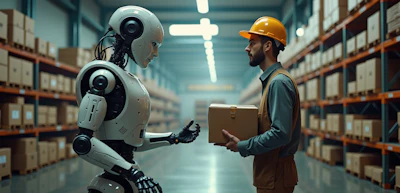
Deploying new technology in the supply chain can be a complicated endeavor. Warehouses are complex ecosystems where people, processes and systems are tightly interconnected to achieve and maintain the needed throughput. Introducing new technologies into that environment can sometimes bring unwanted disruptions or negatively impact efficiency and productivity levels.
Humans play a critical role in how well a technology is deployed and integrated in the supply chain. Warehouse employees are the ones who ultimately use the technology, and their adoption is essential for success. Even if they do not directly utilize the technology, they may work alongside it. Resistance to change is natural, especially if workers feel the new system is complicated or threatens job security. This has become more evident over the last few years as fears of automation and AI replacing human workers has increased.
Successful technology deployments are achieved when companies prioritize human needs alongside technical capabilities to design and maintain systems where both technology and humans work together seamlessly to their fullest potential. To accomplish this often requires a more human-centric approach.
A human-centric strategy strives to identify and deploy technology that helps augment human capabilities and productivity. It’s an understanding that technology investments deliver real value only when they are adopted, trusted and used effectively by the workers in the supply chain. By prioritizing human needs alongside technical capabilities, companies can build supply chains that are not only more efficient, but also more resilient, inclusive and sustainable.
Achieving seamless human/technology collaboration
It’s important to continuously assess and integrate leading-edge technologies to ensure they bring value to customers. This includes a thorough examination of the available technology, as well as its operation and potential use cases throughout the entire supply chain.
Here are four tips to help companies get the most out of their deployments by ensuring a strong collaboration between human workers and technology, such as robotics and automation.
1. Identify the right use cases
One of the most common mistakes is adopting technology without a clear purpose. Technology should serve a clearly defined operational need and align with broader business goals. Without a specific use case, even the most advanced system can become underutilized or disruptive. The key is understanding where technology can solve a real problem or unlock measurable gains.
To identify the right use case, you need to understand your operations and how your existing equipment and people are being used to move product around the facility. This will help you identify tasks that are most easily managed by a new technology or ones that could be more easily accomplished or enhanced through automation. This can include where worker productivity, safety and comfort levels can be improved.
Not every problem requires a high-tech solution. Sometimes simpler process improvements or incremental upgrades deliver a better return on investment. Identifying the right use case helps prevent deploying expensive technology where it is not justified or needed.
2. Plan accordingly to minimize frustration and disruptions
When implementing new technology, determine where your warehouse employees might be supported or even relieved of non-value tasks so they can focus on more strategic work that enhances operational performance. For instance, automation and robotics can handle physically demanding, repetitive tasks such as picking and carton unloading. This can reduce strain and injury while allowing employees to shift into roles that require oversight, troubleshooting, and process improvement.
Challenges in the early stages of deployment can occur when existing workflows have not been considered. Determine what, if any, changes need to be made to ensure a seamless integration and identify opportunities to integrate the technology in a way that respects current workflows and processes, as well as workers that operate within them. If this does not happen, bottlenecks can occur and the affected employees can become frustrated.
Finally, give thought to the workspace the technology will occupy, removing any barriers, providing ample room for robots or other automated equipment to operate, allocating the necessary space from your existing warehouse and restricting access to the area if necessary.
3. Engage with employees throughout the deployment
Open and consistent communication with employees is essential throughout the implementation process. You often have only a small window to communicate clearly with employees, helping to diminish any uncertainty, fears, rumors and resistance. Employees are more likely to embrace technology when they feel they are being heard and understand how the technology may benefit them. For instance, when technology is positioned as a tool to reduce physical strain, improve safety or eliminate repetitive tasks, it is often seen as a positive change and opportunity.
Inform employees about upcoming changes well in advance, including the purpose of the new technology, expected benefits for the organization and workforce, and how roles and responsibilities may evolve. Give them ample opportunities to ask questions and share experiences during the implementation. Providing opportunities for employees to ask questions and share concerns fosters a sense of inclusion and reduces uncertainty. Communication should be ongoing, not a one-time announcement, ensuring that employees remain informed as the project progresses.
4. Conduct structured training and upskilling
Training is a key component of any successful technology implementation and essential to helping ensure safety for anyone working with or around the new technology. Even the most well-designed technology requires onboarding and support. Effective training goes beyond one-time instruction, and can include ongoing coaching, accessible resources and reinforcement. Upskilling not only ensures smooth adoption but also demonstrates a commitment to employee development. Workers who feel supported in building new skills or new roles within the company are more confident and engaged, leading to better outcomes for both individuals and the organization.
After the technology is deployed, consistently follow up to ensure gains are being made and no one has fallen behind. Identify opportunities for additional training or reinforcement and follow through. You should also consider whether you need to revise or expand your safety program to further support safe interaction between the technology and your employees.
In the end, it’s not about choosing between humans or technologies. It’s about designing systems and creating collaborations where each amplifies the other’s strengths. It is about redesigning roles, retraining staff, and rethinking processes to maximize the benefits of both human and technological capabilities. By placing employees at the center of the process, companies are better positioned to unlock the full potential of the investment and enhance supply chain performance, efficiency and resiliency.