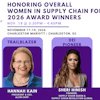
Sheri Hinish is the founder and CEO of Supply Chain Revolution Global LLC, which operates under the Supply Chain Queen brand, where she advises Fortune 500 companies and governments on supply chain transformation, AI-enabled operations, circular economy strategy, and just-transition planning.
She leads strategic advisory engagements that help global organizations embed sustainability and equity into their operating models.
And, she hosts and produces The Supply Chain Revolution podcast, which elevates underrepresented voices, including women, leaders from the Global South, and innovators working outside traditional power structures.
In 2026, Hinish launched Women of the Revolution, which honored 65 women across six continents and three tiers. Hinish also created and manages the SCQ Fellowship, a hands-on professional development program for early-career women entering supply chain, media, and sustainability. The program intentionally recruits women who might not otherwise have access to senior-level mentorship or the professional networks that accelerate careers.
Previously, she spent nearly two decades in the most demanding operating environments in global professional services, rising to senior partner and VP at IBM, where she served as global leader for sustainability services and led teams of more than 3,000 professionals.
She then joined EY as a senior partner, where she helped lead the Open AI and Data Science Challenge, which democratized access to emerging technology skills across a wide talent base, and served on COP Executive Committees from COP26 through COP30, bringing equity and climate-finance perspectives into the highest-level global sustainability governance conversations.
Hinish was named the overall winner of the DEI Pioneer category for this year’s Women in Supply Chain Forum™ award, presented by Food Logistics and Supply & Demand Chain Executive.
Marina Mayer, editor-in-chief of Food Logistics and Supply & Demand Chain Executive and co-founder of the Women in Supply Chain Forum™, sat down with Hinish to discuss the importance of mentorship, sustainability and embracing emerging technologies.
Food Logistics and Supply & Demand Chain Executive: Tell us more about the SCQ Fellowship, and as someone with a strong technology and sustainability-focused background, why the shift?
Sheri Hinish: I’ve always mentored, volunteered and given back. Formalizing it into a program was born from something I experienced firsthand. I am a first-generation college graduate. No one in my family worked in supply chain, let alone had the professional networks that accelerate a corporate career. When I eventually rose through IBM and EY to senior executive roles leading global sustainability and supply chain functions, I recognized how much of career trajectory depends on access: access to mentors who operate at the highest levels, access to real projects rather than theoretical internships, and access to the networks where doors actually open.
The Fellowship is a hands-on professional development program for early-career women entering supply chain, marketing, and sustainability. Fellows receive direct mentorship from me, operational ownership of real deliverables across media production, creative marketing, editorial strategy, and community engagement, and exposure to industry leaders through podcast production, event support, and partnership programming. I intentionally recruit women who might not otherwise have access to any of this. The 2026 cohort includes fellows leading media operations, creative marketing, and community programming, each building a portfolio that translates directly into career advancement.
This is not a departure from my technology and sustainability work. It is an extension of it. What became clear is that the systems-level change I advocate for requires a pipeline of leaders who bring diverse perspectives and lived experience to the table. The Fellowship and our community partners are how I build that pipeline. The shift is not away from technology and sustainability. The shift is toward ensuring the next generation of leaders in those spaces reflect the world where systems and diverse people can thrive.
Food Logistics and Supply & Demand Chain Executive: What emerging technologies have had the greatest impact on your work?
Hinish: Generative AI has fundamentally changed the operating model for independent advisory work. I use AI-powered tools across every pillar of my platform, from podcast production and editorial workflows to scenario modeling for clients navigating supply chain disruption. The ability to synthesize regulatory intelligence, stress-test strategic assumptions, and produce research-grade output at the speed my clients require has compressed what used to take teams of analysts into work I can deliver as an independent, strategic advisor competing with firms that have thousands of consultants. Judgment, context, know-how, and the ability to execute while bringing others along (including pretty large change within the client’s organization) can’t be replaced by AI (despite what you may hear or read).
I remain deeply focused on the convergence of digital twins, satellite-enabled supply chain monitoring, and what I call planetary intelligence: the integration of climate data, geospatial analytics, and operational decision-making into a single strategic layer, particularly upstream. This convergence is where the next wave of competitive advantage lives for enterprises serious about resilience and decarbonization.
Food Logistics and Supply & Demand Chain Executive: What inspired you to pursue a career in supply chain?
Hinish: Supply chain found me. I did not find it. I grew up in a household where the vocabulary stopped at jobs, not careers. College was not expectation, and supply chain wasn’t a word I heard until my 20s.
What found me first was integrated demand planning and procurement, and what I discovered there changed the trajectory of everything. While others saw transactions, I saw systems. While others optimized lanes, I traced the full arc of how a sourcing decision in Southeast Asia connects to a community outcome thousands of miles away. The complexity was not a problem to manage. It was an invitation. I fell in love with how things actually get made and moved around the world, and more importantly, with how innovation could amplify impact and drive more responsible decisions. That perspective did not just shape a career. It became a provocation that I have carried from industry roles through the highest levels of global consulting and into the independent platform I run today.
Food Logistics and Supply & Demand Chain Executive: What supply chain trend do you think will have the biggest impact over the next five years?
Hinish: The forced redesign of global supply chains around geopolitical risk, nature, and new economics will define the next five years more than any single technology. We are living through a period where trade policy, tariff regimes, and industrial policy are shifting faster than most enterprises can reorganize their networks. The companies that will lead are those treating geopolitical intelligence as an operational capability rather than a quarterly briefing topic.
What makes this moment different is the simultaneity: geopolitical fragmentation is happening at the same time as accelerating climate regulation, AI-driven automation of knowledge work, and the collapse of assumptions about where value can be created and captured. I use a framework I call the collapse of the assumption framework to help leaders see that the planning premises they built their supply chains on, including stable trade corridors, predictable regulatory environments, and abundant low-cost labor, are disintegrating in parallel, not sequentially. The organizations that recognize this will build adaptive, geopolitically tiered supply networks. The ones that do not will spend the next five years in reactive mode.
Food Logistics and Supply & Demand Chain Executive: What’s a skill you’ve intentionally developed that has made the biggest difference in your career?
Hinish: Storytelling has been the most transformative skill I have developed, because it is the skill that makes every other skill matter. I learned early in my career, often as the only woman in rooms where decisions were being made, that expertise alone does not open doors. The leaders who shape industries are the ones who can translate what they know into a narrative that moves people to act. I invested in that deliberately, through my graduate work at Harvard and Rutgers, through building a podcast that now reaches more than 50 countries, and through years of speaking on global stages from COP to CES to Reuters.
What changed everything, though, was recognizing that the most powerful use of storytelling is not telling your own story. It is telling the stories of the people the industry has overlooked. When I launched Women of the Revolution and honored 65 women in supply chain and sustainability, I was not simply celebrating achievement. I was using narrative to restructure who our industry recognizes, promotes, and invests in. Storytelling, practiced with that kind of intention, becomes one of the most powerful equity tools available to any leader.
I tell women all the time that their story is their strategy. The ability to own your narrative, to speak with authority about what you have built and what you believe, is not a soft skill’ it’s a core skill. I have built an entire platform around making sure more women shine and have a stage worthy of their voice and contributions.
Food Logistics and Supply & Demand Chain Executive: If you could solve one supply chain challenge overnight, what would it be?
Hinish: I would close the implementation gap between sustainability commitments and operational reality. The industry does not lack ambition. Trillions of dollars in net-zero pledges, circular economy commitments, and Scope 3 reduction targets exist on paper. What is missing is the operational infrastructure to execute them: the data systems, the supplier capability, the financial mechanisms, and the leadership courage to absorb short-term cost for long-term value creation.