Radio Frequency Identification (RFID) is a rapidly growing technology becoming more common in business operations. According to a report by Fortune Business Insight, “the global RFID market size was valued at $15.49 billion in 2024 and is expected to hit $37.71 billion by 2032.” Businesses can use RFID to automatically capture information on packages or tags to track specific items. Encoding RFID tags helps companies access real-time data, reduce costs, and eliminate manual processes such as locating and scanning barcodes.
As supply chains continue to become more complex, the ability to track and trace items accurately and efficiently has become increasingly important.
What is RFID?
RFID is a technology used for tracking inventory and improving supply chain management. Companies are using RFID to create better inventory systems and gain new levels of detail about how their products move through the supply chain. There are two types of RFID tags, active and passive. Active RFID tags consist of a chip, transmitter, antenna, and protective housing and are powered by a battery. Passive RFID tags consist of the chip, antenna, backing material, and protective housing (some tags) and don’t require a battery because they receive their power from the electromagnetism generated by a reading device.
Passive RFID tags are most used in large-scale item-level supply chain tracking and align with global ISO and GS1 standards. While active RFID is used for tracking high-value assets or equipment that require continuous monitoring.
RFID compared to traditional barcodes
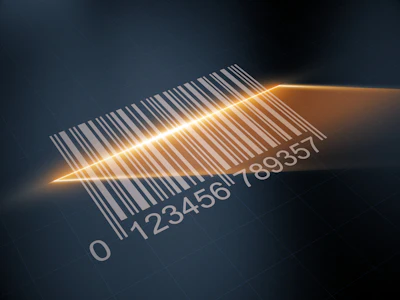
An advantage of RFID over traditional 1D or 2D barcodes is that it doesn’t require a direct line of sight. Barcodes must be scanned individually and directly, which limits speed and requires manual effort. RFID readers can capture data from multiple tags simultaneously, even if the tags are inside boxes or on pallets, providing fast, automated tracking. The automated data capture supports item-level visibility and overall improves efficiency. The connection between the tag and the reader is used to encode the tag with item-unique data, giving organizations item-level visibility that improves operational efficiency. RFID also supports compliance with industry standards set by ISO or GS1, making it ideal for serialized or uniquely identified products.
The use of RFID is growing rapidly across industries. Research for Zebra’s 15th Annual Global Shopper Study found that 97% of retailers plan to deploy RFID technology by 2027, highlighting its increasing importance for inventory accuracy, operational efficiency, and customer satisfaction.
RFID adoption accelerates
RFID has matured from pilot projects to mainstream deployments. Many companies are expanding RFID into their workflows to improve inventory accuracy, omnichannel fulfillment, and loss prevention across complex supply chains.
Standardization plays a critical role in accelerating adoption. RAIN, a global standard for passive Ultra High Frequency (UHF) RFID technology, has made adoption easier by ensuring interoperability among tags and readers. Combined with labeling software integration, businesses can encode, print, and manage RFID tags alongside barcodes in a single, streamlined process.
As regulatory requirements and traceability expectation increase in the future, companies should consider capturing more detailed item-level data without making systems too complex. Three simple ways to respond to RFID adoption are:
1. Ensure your labeling software supports RFID encoding and compliance standards
2. Pilot RFID where it matters most to improve traceability
3. Build hybrid strategies using both barcodes and RFID
By using label design software that supports both barcode scanning and RFID, companies can keep processes simple and training requirements low.
RFID and barcodes: A complementary approach
While RFID provides speed and accuracy, barcodes remain essential for universal identification, regulatory compliance, and cost-effective labeling. In many environments, RFID and barcodes work together effectively.
RFID enables large-scale processes such as receiving, inventory counts, and location tracking without requiring direct line of sight. 1D barcodes support human-driven workflows, allowing warehouse workers, packers, or cashiers to visually verify items and scan them as needed. This dual approach also provides built-in risk mitigation. If an RFID tag fails or is unreadable, a barcode can still be scanned, and if a barcode is damaged or obscured, a RFID tag can still identify the item.
Recently, more companies are transitioning from traditional 1D barcodes to 2D barcodes, which can store more data such as serial numbers, batch information, and expiration dates. 2D barcode and RFID work together by using RFID for automated, high-speed back-end operations like inventory and loss prevention, while 2D barcodes are used for consumer-facing interactions and to provide a visual backup. By combining these technologies, businesses can achieve both operational efficiency and enhanced transparency for customers, using RFID to identify items wirelessly and 2D barcodes to provide a readily scannable and readable layer of data for both automated systems and people.
Barcodes also integrate with mobile devices, allowing employees to scan and update items directly on the warehouse floor or in the field. Voice-guided workflows provide hands-free instructions for picking, replenishment, or cycle counting, further improving accuracy and efficiency. Together, these technologies enhance operational flexibility and accuracy.
How to be successful with a complex supply chain
The greatest supply chain benefits happen when RFID and barcodes work together, supported by mobility and voice tools. Workers can locate tagged items quickly, scan barcodes for verification, and update systems in real time. This approach reduces errors, increases productivity, and enables fully connected, data-driven operations.
By focusing on RFID as the central technology, organizations can build flexible identification strategies that evolve with their needs. Equally important is having a barcode labeling software solution that is RFID capable. Find a labeling provider with the RFID software capabilities and support. With a mix of RFID technology, RFID-compatible labeling, and responsive support, your organization will be able to handle the complexities of the supply chain.