Automation has long been full of promise for the food industry, from manufacturing to shipping and logistics. With enormous capacity, high volumes of products moving in and out, and inhospitable conditions for workers, the warehouse has often served as the focal point for innovation, but to date, much of that promise has gone unfulfilled.
Policy changes are “supercharging cold storage” in 2026, with the recent push for simpler, natural ingredients reducing shelf-stable products and increasing refrigeration needs. These cold chain and warehouse environments can be particularly rough for workers, typically involving extreme cold temperatures, poor visibility, uncomfortable and unstable surfaces, and disorganized objects that shifted during transport. At the loading dock, extreme temperatures can be equally challenging.
Reducing labor challenges and injuries in these environments is one of the key benefits of automation. Research from Lamber Goodnow injury lawyers examines the impact increased automation adoption will have in keeping workers safe from injury over the coming years; among the key findings:
● Transportation and warehousing are the third most dangerous sector for workplace injuries.
● Automation of tasks in transportation and warehousing will reach 31% by 2030.
● Automation gains will reduce injury rates within the sector by 6% for an estimated reduction of 13,690 annual injuries by 2030.
Increased adoption of reliable automation is possible largely due to the recent emergence of AI hardware, machine learning and advanced robotic vision. Businesses eager to further automate their operations can now consider a wide range of in-market, proven solutions already at work.
Loose load trailer and container unloading. A leading manufacturer of industrial robots developed and deployed a robotic trailer/container unloading solution for loose loads that can be driven into the container. It utilizes two robots on an upside down gantry coupled with advanced vision AI to identify the objects, prioritize the order in which to pick and singulate them, and provide precise picking instructions to the robot. The solution is capable of 1,000 picks per hour.
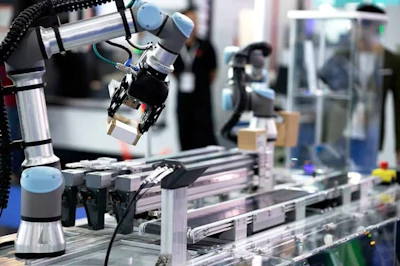
Mixed-SKU depalletizing. A systems integrator partnered with a global supply chain solutions provider to implement a mixed-SKU depalletizing solution that couples a robotic arm with a flexible gripper head, conveyor, camera and advanced vision AI. The vision AI uses the same three-step process of identification, prioritization and precise instructions but also scans the SKUs/labels at the same time for orientation and routing. Capable of handling thousands of different carton sizes, the solution can pick and place up to 750 cartons per hour.
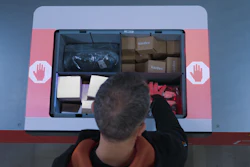
Single-SKU picking and sorting to mixed-SKU destinations. A warehouse automation company developed a fully-automatic bin picking solution that picks from a single-SKU source, placing objects into multiple mixed-SKU destination bins. The solution consists of a high-speed and lightweight robotic arm, camera and advanced vision AI, achieves 1,200 picks per hour and integrates with the company’s warehouse bin retrieval system for seamless and continuous operation.
Ingredient intake via heavy bag depalletizing. An industrial automation company focused on heavy-load transport developed a heavy bag depalletizing solution for ingredient intake. A robotic arm is paired with advanced vision AI. Beyond the identification and prioritization of bags for picking, the vision AI accounts for shifting contents within the bags when it provides the optimal grasp strategy to minimize damage. The solution picks and places heavy bags exceeding 25kg from variable pallet stacks at a rate of more than 400 bags per hour and is capable of reaching 1,000 bags per hour.
Prior to the emergence of AI hardware enabling advanced vision capabilities, even the best automated solutions were unavailable or unreliable. Legacy mix-SKU depalletizers, for example, were prone to error rates as high as 30%, requiring frequent manual intervention, while heavy bag depalletizing was considered one of the unsolvable automation problems due to errors and damage resulting from weight shifting and other difficult-to-account-for variables.
New AI processors and graphics processing units (GPUs), originally designed for gaming, deliver incredible computing power directly to a robot through edge computing deployment, providing more than enough local computing power to think and act in milliseconds, opening up a new world of automation possibilities for the warehouse and beyond.
Fueled by AI advancement, some of the largest warehouse operators in the world continue to develop and enhance their own automated solutions and invest in companies to move them forward. As these solutions prove viable on a large scale, more companies will seek to deploy them in both brownfield (existing) and greenfield (new) implementations to increase operational efficiency.
Thanks to these new AI capabilities, the need to accommodate more fresh and less shelf-stable foods and workforce health and safety concerns, warehouse automation is finally fulfilling its potential in cold storage and throughout the warehouse.