Foodservice is one of the most labor-intensive segments of the food supply chain, and right now is also one of the most fragile. The industry employs 15.9 million people in 2025 and is projected to add another 200,000 jobs this year, yet table-service operations are still running 233,000 positions below pre-pandemic staffing levels, according to the National Restaurant Association. The Great Resignation gave way to what economists now call the Great Stay, but staffing remains a persistent strain on operators, distributors, and every link of the food chain that touches them.
The truth is, labor management in foodservice is not a hiring problem. It is an operational design problem.
When restaurants and foodservice operations are short-staffed, the entire downstream chain feels it. Food sits longer between prep and plate. Order accuracy dips. Inventory tasks slip. Trucks arrive at receiving docks with no one to log them in. Managers lose visibility into where labor is actually being spent, and food, the most perishable inventory in any logistics network, starts to absorb the cost of that delay.
This is the gap automation is closing.
Treat labor like a logistics problem, not a hiring problem
The operators who get the most out of automation are not the ones asking which robot to buy. They are the ones asking where labor is getting trapped in repetitive, low-value tasks. That is the right place to start.
In a high-volume restaurant, the answer is often the same: food running, beverage delivery, busing tables, transporting items between back of house and front of house, moving inventory from receiving to storage. These are hand-offs in a logistics network, and like any logistics network, they reward consistency and predictability.
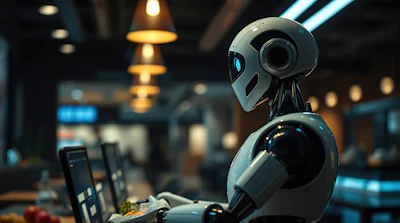
A practical example is the rollout of autonomous service robots inside different foodservice outlets. Autonomous units handle drink runs and food delivery to the table, while smart conveyor systems move prepared dishes from the kitchen line to the customer. Servers stop logging miles between the kitchen pass and the dining room and start spending their time on the part of the job that drives loyalty and check size: actually serving the guest.
The food still moves. The throughput goes up. The labor footprint stays the same, or shrinks.
The software layer is the real innovation
The robot is the visible part of the system. The software layer is where the value lives.
Modern foodservice automation is not a standalone machine. It is an integration between order management, kitchen display systems, point of sale, inventory tracking, and the autonomous fleet on the floor. When an order is placed, the software queues the right tasks for the right operator, human or robotic, in the right sequence. The robot is dispatched at the exact moment the food is ready. Idle time falls. Congestion at the kitchen pass falls. The data the system captures along the way is used to refine routing and scheduling for the next shift.
McKinsey & Company describes a future foodservice operation that looks more like a manufacturing line than a traditional restaurant: automated kitchens, AI-driven personalization, and unbundled service formats that let operators flex labor and capacity as demand shifts. Full automation is neither realistic nor desirable. Partial automation, applied to the right tasks, is already pulling cost and unpredictability out of the system today.
Safety, retention, and the hidden ROI
Repetitive transport in a hot, fast-paced kitchen is one of the leading sources of soft-tissue injuries in foodservice. Every plate carried across a busy floor, every tray walked from prep to dish pit, every pallet moved from receiving to cold storage is a chance for a back, a knee, or an ankle to give out. When operators offload that physical layer to autonomous systems, injury rates drop, claims drop, and the workforce becomes more sustainable.
That is the ROI executives rarely model up front and feel the most when it is missing. Lower injury rates protect labor availability. Higher retention protects training investment. Both flow directly into the bottom line of any operation already running on a thin labor margin.
Deloitte's research on AI in restaurants reinforces the point: the operators making real progress are the ones using technology to support the workforce, not replace it. None of these systems are taking the human out of foodservice. They are taking the repetitive layer out from between people and the work they were actually hired to do.
Where operators should start
For foodservice and food logistics leaders deciding where to act, the starting point is not technology. It is exposure.
Map the three or four points in your operation where labor most often breaks down: peak-hour table runs, kitchen-to-pass hand-offs, receiving and put-away in the back, ware-washing logistics. Pick the one with the highest cost when it fails and the most repetitive task profile. That is the use case for automation.
Run a single deployment. Measure the impact on throughput, accuracy, injury rates, and retention. Then scale based on results, not on press releases.
A few principles separate the operators who succeed from the ones who stall:
· Treat the deployment as a process redesign, not a product purchase. The robot is one moving part inside a redesigned operational flow. Without the redesign, the robot is just a $30,000 paperweight.
· Assign a named owner for every automated task. If nobody is accountable for what the system produces, nobody will notice when it starts to drift.
· Bring the operators in early. The line cooks, servers, and shift leads who actually run the floor know exactly where labor is getting wasted. They are the most reliable guide to the right starting use case.
The bottom line
The foodservice and food logistics operators who win in the next five years are not the ones with the most robots. They are the ones who treat labor like a logistics problem and design the work, the tools, and the people around moving food through the operation as efficiently and as humanely as possible.
You do not deploy a robot. You deploy a workflow.