Grocery supply chain leaders face an unprecedented and enduring challenge in workforce shortages. According to a 2024 Descartes survey, 76% of supply chain leaders report workforce shortages in warehousing, transportation, and manufacturing. These shortages are accelerating automation and AI adoption in the supply chain. ABI Research’s 2025 Supply Chain Survey found that 64% of supply chain leaders consider AI essential when evaluating new technology investments and 94% plan to use it to support decision-making processes.
Tariffs, trade policy shifts, and global disruptions create volatility and compel organizations to strike a balance between operational demands and resilience.
McKinsey research shows that many firms still under-invest in the capabilities needed to survive these pressures. For grocery distribution centers, where margins are tight, demand is variable, and product sensitivity is high, this convergence of labor constraints points to the well-understood fact that automation is imperative.
Moving from experimentation to execution in automation
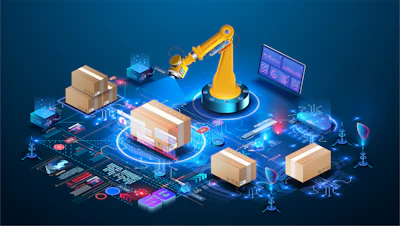
AI, robotics, and warehouse automation technologies have quickly moved from pilot programs to essential tools in the food industry. Robot orders in the food and consumer goods sector surged by 85.6% in the first half of 2024.
Early adopters of AI in supply chains have reduced inventory by 20-30%, lowered logistics costs by 5-20%, and saved 5-15% in procurement spend.
These automated systems can predict disruptions, reroute workflows, and reposition inventory.
Meanwhile, drones are reducing delivery times, lowering operational costs, and improving accessibility to remote areas. Major grocery retailers are now deploying drone delivery at scale, with Walmart and Wing rolling out drone fulfillment in 100 stores across five U.S. metro areas in 2025.
Reshaping roles on the warehouse floor
Think of the current state of the warehouse floor. Manual case picking, pallet breakdown, and the monotonous movement of materials increase the likelihood of injury and employee turnover. Automation of some kind, whether it is through robotics, autonomous mobile robots, or sophisticated material handling systems, reduces the physical strain and increases the consistency of throughput. This kind of shift carries serious implications from a safety and retention perspective. Less repetition and fewer manual lifts mean fewer injuries in the workplace.
Workers subject to technology-driven, predictable workflows report increased job satisfaction. This is essential for employers trying to attract talent in a competitive labor market. Automation shifts headcount away from repetitive and physically demanding tasks to more skill-based roles. For this reason, upskilling and training programs are as important as other types of investments. Warehouse associates are adapting to roles such as equipment maintenance, data analysis, and systems supervision.
Efficiency and resilience must coexist
Global volatility has shown the effects of over-optimization. For instance, new tariffs have affected 20-40% of supply chain activity, resulting in landed-cost uncertainty, which makes forecasting and pricing strategies difficult.
While macro environmental impacts cannot be controlled, automation can improve resiliency by boosting inventory, and reduce internal volatility by improving workflow speed and consistency across distribution operations. However, automation alone is not sufficient for resilient food supply chains. Supporting infrastructure like packaging must also evolve to function effectively in automated environments.
Automated warehouses rely on standardized, rigid packaging, free of dust and debris. In the grocery supply chain, frequented with heavy and wet products, compromised box shape integrity brings automation to a full stop. Likewise, corrugated dust and debris, as well as dunnage and warped/broken pallets, cause machine jams, often requiring engineering support to resume the line.
The data and traceability connection
As of today, 70% of food manufacturers use digital traceability, and the supply chain traceability market is expected to grow at a double-digit rate over the next 10 years. Grocery operations, especially with fresh and perishable products, can greatly reduce shrink with the help of this technology by capturing real-time data on condition, temperature, and handling history. Traceability also ensures compliance as regulations like EPR and FSMA 204 come into effect.
But perhaps its most impactful application is realized when applied to AI tools. AI is already handling predictive analytics, autonomous logistics, and real-time decisions. Over the next few years, it’s expected to expand from managing specific tasks to orchestrating the entire supply chain. However, AI is only as powerful as the data it can obtain, so traceability is a key component of its usefulness and accuracy.
Automation in the age of e-commerce
With online grocery sales projected to account for 17% of total grocery sales by 2029, automation will provide the necessary speed and accuracy to keep pace with orders, growing more challenging with such as smaller orders, rapid fulfillment expectations, and SKU proliferation.
Traditional pallet-in, pallet-out distribution models are not designed for high-volume, individual item-picking. Automation technologies, like goods-to-person systems, micro-fulfillment centers, and robotics, enable higher-density storage and faster order assembly while minimizing labor intensity.
Balancing cost pressures
Capital investment is still a major consideration, but automation is increasingly viewed as a strategic necessity rather than a discretionary upgrade. Persistent workforce shortages reported by 76% of logistics and supply chain operators are forcing grocery leaders to rethink manual processes and invest in technologies that can maintain throughput. As a result, automation adoption is continuing to accelerate, particularly in warehouse robotics and automated material handling systems.
Delaying automation can carry its own costs, like persistent labor shortages driving overtime and temporary labor spend, manual inefficiencies increasing shrink and product damage, and limited visibility leading to higher safety stock and working capital requirements.
The most successful organizations are approaching automation as part of a broader operational redesign rather than a standalone technology purchase. They are aligning automation investments with packaging optimization and reusable transport solutions to create compounded efficiencies.
The way ahead
The volatility of supply chains will not change, and the next decade of grocery logistics will be defined by structural workforce limitations, uncertain tariffs, the growth of e-commerce, and sustainability regulations.
Automation in and of itself provides resiliency, but a broader approach encompassing traceability, packaging optimization, and network design, automation future-proofs your supply chain, increases profit, and decreases risk. The grocery supply chains that will succeed are those moving from reactive modifications to purposeful redesign.
Tomorrow's leaders are not just adding automation to existing processes. They are transforming the warehouse into a data-driven, flexible, and safer environment built to remain competitive in a challenging macro environment of constant change, while meeting the ever-increasing service levels customers expect.