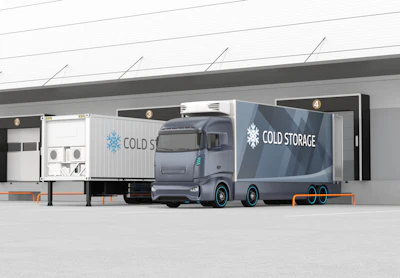
For producers and shippers of perishable goods, the last mile is where freshness is won or lost. As cold chain logistics comes under increasing scrutiny from retailers and consumers alike, a growing body of food safety science points to one specific number as the gold standard for perishable shipping: 0°C (32°F), the temperature just above the freezing point of most perishable products.
The science behind 0°C
Temperature is the single most important variable in perishable food preservation. Holding product at its pre-freezing point—roughly 0°C—delivers three distinct advantages over warmer or colder alternatives.
First, it suppresses bacterial growth. Pathogens such as Salmonella and Listeria multiply rapidly once food enters the "danger zone" above 4.4°C (40°F). Keeping product near 0°C dramatically slows microbial activity and extends the safe shelf window.
Second, it slows metabolism and enzymatic activity. Fresh seafood, meat, and most dairy products contain enzymes that drive ripening, aging, and eventual spoilage. Cooling to 0°C suppresses these processes, preserving texture, flavor, color, and nutritional value far longer than standard refrigeration allows.
Third, it avoids freeze damage. Deep freezing at -18°C (0°F) halts bacterial activity almost entirely, but pushing perishable products below their natural freezing point risks ice crystal formation that ruptures cell structure, degrading quality permanently. Holding products just above that freezing threshold preserves cellular integrity while still delivering near-maximum preservation benefits.
The limitations of carrier-operated refrigerated shipping
In carrier-operated refrigerated shipping, the temperature actually maintained depends entirely on the refrigeration infrastructure used throughout the transit route—cold storage at distribution centers, refrigerated containers, and airport warehouses among them. Within this chain, holding a consistent 0°C is inherently difficult, and products risk both freezing and overheating due to:
1. Temporal fluctuations caused by the periodic on/off cycling of refrigeration units.
2. Spatial unevenness in temperature distribution within containers and depot cold rooms.
3. Inherent limitations in temperature measurement due to sensor accuracy and placement.
The ice pack advantage: Consistent 0°C at the unit level
Insulated shipping boxes with ice packs offer a fundamentally different approach: decentralized temperature control at the shipment level rather than the facility or vehicle level. Properly configured, these systems maintain a consistent product temperature of 0°C throughout transit, independent of ambient conditions or warehouse and vehicle infrastructure.
This consistency matters in two ways. First, it delivers the freshness benefits described above more reliably than standard cold-chain refrigeration alone. Second—and just as critical for producers—it standardizes quality across every shipment. An ice-packed insulated box holding 0°C performs the same way whether it's shipment one or shipment one hundred, eliminating shipment-to-shipment variability and giving producers a consistent quality guarantee regardless of route or carrier.
The most effective approach combines standard refrigerated carrier transport with ice-packed insulated boxes: the carrier's cold environment serves as a buffer, while the insulated container does the precision work of holding product near its ideal pre-freezing temperature.
The hidden problem: Ice pack logistics is still guesswork
Despite these advantages, ice pack shipping has a problem the industry rarely discusses openly: getting it still depends heavily on tribal knowledge.
Determining ice pack weight and insulated box specifications remains an art, not a science. Given a shipment's specific conditions—product type, destination, route, transport method, duration, and ambient temperature—most shippers have no reliable way to know how much ice pack weight is needed or which insulated-box specification is appropriate. Decisions are typically made by experienced staff based on intuition and previous cases.
Validation requires physical testing. Confirming that a configuration is safe means running physical trial shipments—packing real product and ice packs into insulated boxes and tracking temperatures over time. This requires specialized monitoring equipment and labor, adding cost. Worse, results from any single trial have limited applicability: change the product, box size, ambient temperature, destination, transport method, or add a second delivery point, and the previous results may no longer hold.
Fear drives over-packing. Faced with this uncertainty, shippers' natural response is to add a safety margin—often a large one. Fear that ice packs will melt before delivery, spoiling the product, leads many to over-pack "just in case." But every extra kilogram of ice pack adds directly to shipping weight and cost, quietly eroding margins shipment after shipment.
The path forward
The case for 0°C as the optimal preservation temperature is well established in food science. The case for ice-packed insulated boxes as the most reliable way to deliver that temperature consistently, shipment after shipment, is equally strong.
The next frontier for last-mile cold chain innovation is to replace guesswork and costly trial shipments with predictive, repeatable methods for selecting ice pack weight and insulated box specifications. For producers competing on freshness, getting this right isn't just an operational detail — it's the difference between a guaranteed quality shipment and a gamble.










![Top Tech Logo 2026 Vertical [color]](https://img.foodlogistics.com/mindful/acbm/workspaces/default/uploads/2026/04/top-tech-logo-2026-vertical-color.mWl7RAiZmg.png?ar=16%3A9&auto=format%2Ccompress&bg=fff&dpr=2&fill-color=fff&fit=fill&h=135&q=70&w=240)


