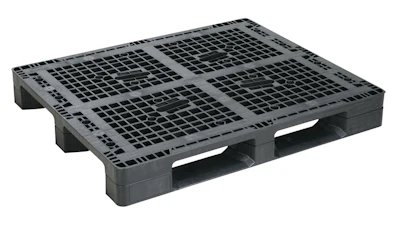
Reusable plastic pallets help food manufacturers and distributors reduce waste while improving operational efficiency, lowering total supply chain costs, and supporting sustainability goals through predictable performance, durability, and measurable environmental impact.
- Durability and consistency: Unlike wood pallets, reusable plastic pallets deliver predictable performance throughout their service life, supporting automated equipment and reducing downtime.
- Measurable sustainability impact: Packaging Life Cycle Assessments (LCA) quantify environmental benefits including greenhouse gas emissions, energy consumption, and waste reduction across the pallet's lifecycle.
- Technology-enabled tracking: RFID, GPS, and IoT integration provide real-time visibility into pallet location and usage, reducing asset loss and increasing asset turns for greater value.
- Circular economy advancement: Using post-consumer recycled resin (PCR) in reusable pallets diverts plastic waste from landfills while reducing reliance on virgin fossil-based plastics.
- Implementation best practices: Success requires clear metrics, pilot programs, proper pallet selection, and continuous monitoring to maximize both operational and environmental returns.
Food manufacturers and distributors today face increasing pressure to reduce waste, improve operational efficiency and meet ambitious sustainability objectives. They cannot afford to sacrifice product protection, food safety or supply chain performance when meeting these objectives. The challenge is finding solutions that support both environmental initiatives and measurable business results.
Reusable plastic pallets have become a key part of this equation. Beyond reducing waste, they help companies improve operational performance, lower total supply chain costs and support long-term sustainability initiatives. Companies are able to recognize the greatest value when sustainability efforts are aligned with operational improvements that can be quantified and sustained over time.
Balancing sustainability with business performance
While environmental benefits are important, companies also need solutions that improve efficiency, reduce costs and deliver consistent performance throughout the supply chain.
Reusable plastic pallets help grocery stores, foodservice manufacturers and distributors improve food safety, reduce product damage and keep products moving efficiently through production, storage and delivery. The durability and long service life allow these pallets to be reused repeatedly, helping organizations reduce waste while lowering total ownership costs over time and demonstrating a return on investment (ROI).
Unlike wood pallets, whose condition changes over time, reusable plastic pallets deliver predictable performance throughout their service life. That reliability supports automated equipment, reduces downtime and helps improve operational efficiency across manufacturing, warehousing and distribution.
As supply chains become increasingly automated, packaging consistency becomes even more important. Reliable pallet performance helps products move efficiently through production and distribution while minimizing interruptions that can affect productivity.
Measuring sustainability impact with meaningful data
As sustainability reporting becomes more sophisticated, companies increasingly need data to support environmental claims. Documenting sustainability performance helps organizations understand the impact of their packaging decisions while displaying progress toward broader corporate objectives.
One of the most effective ways to quantify the environmental impact of reusable plastic pallets is through a Packaging Life Cycle Assessment (LCA). These assessments evaluate factors such as greenhouse gas emissions, energy consumption, water use and waste generation across the pallet’s lifecycle. They also provide an objective way to compare reusable plastic pallet systems with alternative pallet options.
Sustainability initiatives are most successful when they demonstrate business value. Organizations evaluating reusable plastic pallets should consider an asset’s entire lifecycle rather than focusing solely on the initial purchase price. Measuring total ownership cost, including operational efficiencies, product protection, long service life and reduced downtime provides a more complete understanding of the business value reusable plastic pallets can deliver.
Another important sustainability strategy involves incorporating post-consumer recycled resin (PCR) into reusable packaging. Giving recovered plastic a second life reduces reliance on virgin plastic produced from new fossil-based resources while diverting plastic waste from landfills. This advances circularity by reducing reliance on virgin plastic while supporting broader circular economy initiatives.
Together, packaging LCAs and using PCR help organizations align reusable pallet programs with the corporate sustainability objectives they already track, focusing on reducing waste, avoiding greenhouse gas (GHG) emissions, conserving resources or supporting broader environmental, social and governance (ESG) objectives. Companies, rather than relying on assumptions, can use measurable data to demonstrate how reusable packaging contributes to corporate sustainability objectives.
Using technology to maximize reusable packaging performance
Technology is also changing how companies manage reusable assets throughout the supply chain. By integrating technologies such as RFID, GPS and IoT-enabled tracking, organizations can gain real-time visibility into where reusable plastic pallets are located, how they are being used and when they should be returned for reuse.
This level of visibility delivers operational benefits that extend beyond inventory management. Better asset tracking helps reduce asset loss and the need for replacement pallets. It can also shorten dwell time and increase asset turns, allowing reusable pallets to remain in circulation longer and deliver greater value over their service life.
Improved utilization also supports sustainability objectives. When reusable assets stay in circulation longer and few pallets need to be replaced, organizations generate less waste while reducing the resources required to manufacture replacement assets. Operational efficiency and environmental performance become mutually reinforcing rather than competing priorities. As digital technologies continue to evolve, asset visibility will become an increasingly valuable tool for companies seeking to maximize both the financial and environmental return on their reusable packaging investments.
Best practices for building a successful reusable plastic pallet program
Successfully implementing a reusable plastic pallet program begins with clearly identifying key success metrics. Companies should identify both operational and sustainability objectives while establishing the key metrics used for measuring progress.
Selecting the right pallet for the application is equally important. Factors such as load requirements, storage environment, automation compatibility and distribution network considerations all influence long-term program performance. Before implementing a large-scale conversion, organizations should consider piloting reusable plastic pallets with a portion of their operation. Pilot programs allow companies to validate assumptions, gather performance data and refine processes before expanding across the network.
Working with a trusted reusable packaging partner can also help simplify implementation. From business case development and sustainability assessments to product selection expertise and implementation support, experienced partners can help organizations identify the solution that best aligns with both operational and environmental objectives.
Finally, implementation should not be viewed as the finish line. Companies that track operational and environmental results and identify continuous improvement opportunities are often best positioned to realize the full value of reusable packaging and scale successful initiatives across the network.
As food supply chains continue evolving, companies will increasingly seek solutions that improve efficiency while supporting sustainability objectives. Reusable plastic pallets offer an opportunity to achieve both. When supported by measurable data, enabled by technology and implemented with clear business objectives, they can help companies drive waste out of the supply chain while delivering operational value.