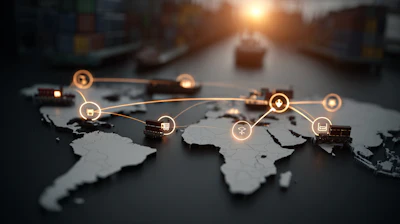
Most food logistics operators have mapped their supply chains. They know where their carriers run, where cold storage sits and how product flows from origin through fulfillment to shelf. That mapping work matters — it underpins compliance, traceability and risk management.
But here's the gap: The map gets built once and then trusted indefinitely, while the network it represents changes around it. A route that worked last quarter now runs through a carrier with capacity constraints. A cold storage facility that anchored the distribution plan has shifted its receiving windows. A regional hub added a second shift, but the planning assumptions still reflect the old one.
In ambient freight, that drift is manageable. In perishable food logistics, it compounds fast. Cold chain failures alone cost the industry an estimated $35 billion every year, and much of that loss traces back to decisions made on assumptions that no longer hold.
The real cost of a map that doesn't match your network
When routing decisions are made from outdated data, the consequences hit hardest in last-mile perishable networks. A driver encounters congestion on a route planned without current traffic conditions. The delivery window closes. The receiving dock turns away the late arrival. Fresh produce sits in the vehicle longer than the cold chain can sustain, and the load is compromised before anyone knows there's a problem.
What makes this worse is that most legacy systems only track status milestones — "dispatched," "in transit," "delivered." They don't flag developing situations or signal when intervention could still change the outcome. A temperature-sensitive shipment can be moving through your network around the clock, but if an exception needs a human decision — rerouting a load, approving a carrier swap, authorizing a hold — that decision waits for whoever is responsible to be available and informed. In a multi-region operation, that lag can span hours.
The numbers bear this out. The USDA estimates that 30–40% of the U.S. food supply is wasted, and the global cost of food waste is forecast to reach $540 billion in 2026, with distribution and logistics accounting for a significant share. Yet 61% of food businesses say they still lack full visibility into where that waste actually occurs in their operations. That's a telling gap. The loss is measured in billions, but most operators can't pinpoint where in the chain it happens.
There's also a compliance dimension that static maps miss entirely. Traceability requirements in food logistics — especially under regulations like the FDA's FSMA Rule 204 — depend on granular event data, like which batch moved on which vehicle, through which facility and under what temperature conditions. Your network topology diagram doesn't tell you what actually happened during a specific shipment. When a recall event requires you to trace product through the chain quickly and accurately, the gap between your documented network and your actual operational data becomes a liability — one that regulators and insurers will measure in days and dollars. And as traceability mandates tighten across the United States and EU, that gap becomes harder to explain away.
What operators who get this right actually do differently
The operators who handle this well treat their supply chain map as a live operational input, not a reference document built at a point in time.
In practice, that means three things:
- Visibility across the full journey, not just status confirmations at dispatch and delivery. In perishable networks, the risk lives in the handoffs, the dwell times and the legs where product moves between facilities. With first-attempt delivery failure rates running 8%-20% across last-mile networks, there are a lot of moments where the product is sitting somewhere it shouldn't be. Those are exactly the points that milestone-based tracking misses.
- Routing that updates against live conditions rather than planned ones. If a carrier's on-time performance has dropped over the past fortnight, that should change which loads they get assigned tomorrow, not sit in a spreadsheet until the next quarterly review. The best operators I've worked with run weekly carrier SLA cross-checks against actual delivery data instead of annual benchmarks.
- Exception handling that triggers automatically rather than waiting for someone to notice and escalate. The window for a useful intervention in cold chain logistics is often measured in minutes, not hours. By the time a human spots the problem in a dashboard, the product may already be compromised.
The question worth asking on Monday morning
Supply chain mapping is sound practice. The mistake is treating it as a project, something completed and filed rather than a discipline that runs continuously alongside operations.
The practical test is simple: Does your map reflect what's actually happening in your network this week? Are carrier SLAs, routing assumptions and cold chain protocols being validated against live operational data or against last year's planning exercise? If your team can't answer that confidently, the map isn't protecting you. It's giving you false confidence while the network moves on without it.









![Top Tech Logo 2026 Vertical [color]](https://img.foodlogistics.com/mindful/acbm/workspaces/default/uploads/2026/04/top-tech-logo-2026-vertical-color.mWl7RAiZmg.png?ar=16%3A9&auto=format%2Ccompress&bg=fff&dpr=2&fill-color=fff&fit=fill&h=135&q=70&w=240)