The story of U.S. food production has long been centered around “Big Food,” sprawling plants with vast headcounts, high-volume output, and easily repeatable processes designed for scale. But in the last few years, a different narrative has begun to emerge. Regional slaughter and further-processing facilities, often founded by operators who’ve stepped away from corporate food giants to build smaller quality-first businesses, are increasing in number. The interesting thing about these smaller, community-anchored plants is that they aren’t trying to outproduce their big industrial counterparts. Instead, they’re trying to outflank them with speed and agility. With leaner teams and shorter decision chains, they can adapt to local demand, trial new products faster, and maintain closer relationships with suppliers and customers. Their rise is also a direct reflection of consumer appetite for clean-label products and local provenance – food that’s fresher, more transparent, and closer to home.
The challenge, however, is that agility alone doesn’t solve the need for rigorous Hazard Analysis and Critical Control Points (HACCP) programs – the bedrock of food safety compliance. Without the sheer manpower of larger plants, these smaller facilities need smarter ways to keep pace with both regulatory demands and consumer expectations.
While large enterprises or “Big Food” primarily adopt AI as a way of increasing efficiency and reducing costs, for regional plants it is becoming something far more precious – a force multiplier. The same technology that powers predictive analytics in manufacturing may soon be applied to compress weeks of food safety expertise into minutes of guidance, allowing lean teams to operate with the same rigor and attention to detail as the big players. That will result in safer food, yes, but it will also build business resilience and compliance, allowing even the smallest plants and processing facilities to orchestrate allergen sequencing conflicts before production starts, or simulate hazard analysis for new recipes within hours. Thanks to AI, there will no longer be a choice between speed and compliance.
AI as an HACCP accelerator
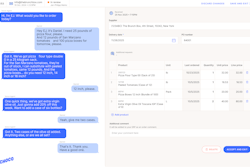
One of the most resource-intensive parts of running a food plant is keeping HACCP programs current. In the past, drafting or updating a hazard analysis for a new product meant hours of phone calls, emails, and consultation with industry experts or academic partners just to get guidance on what hazards to consider for a new process. With AI, that expertise can be accessed and acted upon within minutes. By simply inputting an ingredient list or process description, AI can generate a preliminary hazard profile, highlight potential critical control points, and even stress-test the plan against historical data. So, what once took weeks of coordination can now be achieved in the time it takes to run a query – that’s the very definition of a force multiplier.
It will also be interesting to see how day-to-day operations evolve in the wake of AI. Take scheduling, for instance. Industry players know all too well that human error in allergen run order can trigger costly production holds and recalls, with entire trailers of products often lost to landfill. But AI systems can scan schedules, cross-check allergen sequences, and flag conflicts long before they even make it onto the floor. The same is true of equipment-level data streams – once logged manually by operators walking the floor, they can now be fed directly into digital platforms. Over time, AI will start to monitor for deviations by learning from historical patterns to predict where future breakdowns or compliance risks might occur. By catching issues upstream, plants reduce waste, protect margins, and prevent food safety failures that can erode consumer trust.
Beyond the 4 walls
For all the ways facilities might capitalize on AI in their own operations, food safety has never been confined to what happens inside a single building. Even the most diligent HACCP plan can be undermined if upstream or downstream risks aren’t fully understood. Audits and certifications from suppliers may look reassuring on paper, but they rarely tell the whole story. A facility may earn top marks, yet sit downstream from a dairy whose runoff contaminates irrigation water, or operate in a region prone to environmental hazards that never show up in a standard checklist. These blind spots can create the conditions for major recalls, as the leafy greens industry learned when E. coli traveled from nearby livestock operations into irrigation systems.
By aggregating data from maps, supplier audits, environmental reports, and even satellite imagery, AI can help identify risks that fall outside the traditional four walls of a plant. Instead of discovering too late that a supplier’s “A+” audit masked a vulnerability in their surroundings, processors can surface those risks earlier and build them into hazard analyses and preventive controls.
Learning to walk before running with AI
All industries are still very much in the “bandwagon” days of the AI gold rush. Businesses are keen to adopt it and start reaping the benefits from Day 1, but rushed deployments often end up being more costly in the long run. This is particularly true of smaller facilities who might not have the financial resilience or “bouncebackability” that some of their larger counterparts have. They need to begin with practical experiments and applications that fit naturally into their existing workflows.
One example might be using computer vision as a “sanitation scout.” By photographing a new piece of equipment from multiple angles, AI can flag likely harborage points like hinges, shadowed welds, or drains that might escape the human eye during installation checks. Instead of waiting for high micro counts to surface weeks into production, plants can tighten Sanitation Standard Operating Procedures (SSOPs) up front, reducing the risk of pathogens gaining a foothold. Early wins like this build confidence while proving that AI is more than just a boardroom buzzword.
And of course, keeping humans in the loop is absolutely essential. AI still depends on the quality of the inputs it receives – the old mantra, “garbage in, garbage out” is as true now as it ever was. That’s why a new skill set is emerging on the plant floor: prompt craft. Operators are learning how to frame the right questions for AI systems and how to interpret confidence scores in context. Supervisors, in turn, are making judgment calls about when to auto-approve AI-driven suggestions and when to escalate for human review. So, far from replacing people, AI is actually empowering them, freeing them from repetitive tasks so they can apply themselves to decision-making and other high-value areas of the business.
AI promises efficiency and compliance, which is a win in and of itself. But it also provides an opportunity to rewrite the rhythm of food safety itself. When hazard analyses, sanitation checks, and supplier reviews become continuous rather than episodic, small facilities stop playing catch-up and start setting the pace. In that sense, AI isn’t leveling the playing field – it’s reshaping it, giving smaller regional facilities the tools to prove that rigor and resilience aren’t necessarily tied to size and scale.