The logistics automation market is set to grow from its current market value of more than $35.9 billion to over $104.9 billion by 2035, as reported in the latest study by Global Market Insights, Inc.
The market expansion is influenced by the strategic importance of logistics in national economies, as it significantly contributes to gross domestic product (GDP) across multiple countries.
Governments and private stakeholders are increasingly investing in upgrading logistics infrastructure to improve productivity, efficiency, and global competitiveness.
Key takeaways:
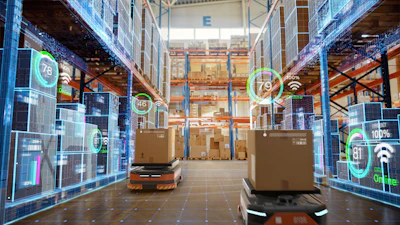
· Modern logistics operations are rapidly shifting toward intelligent automation, where AI and machine learning technologies are evolving from isolated optimization tools into fully integrated orchestration systems. These platforms now manage end-to-end workflows by coordinating inventory, labor, and transportation in real time.
· Research findings also indicate that higher levels of automation and robotics density significantly improve operational efficiency when supported by effective system integration and workforce adaptation.
· The hardware segment accounted for 58.3% share in 2025, generating $21 billion attributed to the capital-intensive nature of physical automation infrastructure, including conveyors, automated storage and retrieval systems, palletizing units, autonomous mobile robots, automated guided vehicles, and robotic lift equipment.
· The large enterprises segment held a 66.1% share in 2025, valued at $23.8 billion. This leadership position is driven by the high capital requirements associated with large-scale automation deployments, which are typically accessible to financially strong organizations. Major adopters include global retail chains, e-commerce leaders, and third-party logistics providers that operate across multiple facilities.
· U.S. logistics automation market reached $10.9 billion in 2025 and is projected to grow at a CAGR of 12.3% from 2026-2035. The country's highly developed logistics ecosystem continues to attract strong investments in automation technologies. Growth is supported by rapid expansion of e-commerce, increasing labor shortages in warehouse operations, and widespread adoption of robotics and AI-driven systems.
· Industry surveys indicate that a significant share of logistics decision-makers in the region expect growing reliance on artificial intelligence while also highlighting rising concerns around cybersecurity risks in automated supply chains.
· Many players are investing heavily in scalable automation systems that support flexible warehouse configurations and real-time decision-making capabilities. Strategic partnerships with e-commerce platforms, logistics service providers, and industrial operators are helping firms expand deployment opportunities across multiple sectors. Companies are also prioritizing software-hardware integration to improve system interoperability and operational efficiency. In addition, continuous investment in predictive analytics, digital twin technologies, and cloud-based warehouse management systems is strengthening performance optimization.