The rules of warehouse management have evolved. Today’s facilities are increasingly adopting automation and advanced technologies to strengthen their competitive edge. Not long ago, automated lift trucks seemed out of reach for many operations due to high upfront costs and uncertain payback. However, expanding rental and leasing options have significantly lowered the barriers to entry.
Research shows that robotic forklifts can cut labor costs by as much as 32%, and over time, they can reduce expenses further through increased productivity and less maintenance and equipment needs. Additionally, businesses don’t need to commit to a full fleet from the start, beginning with a single automated truck as a pilot project makes it easier to demonstrate value before scaling up to more units.
Here’s how operations can build a strong financial case for automated lift trucks, achieve quick ROI and unlock long-term savings.
Reducing labor costs
Today’s warehouse labor challenges require a different approach, one that transforms the way work gets done. Although spending on warehouse construction dipped in 2025, it’s expected to rebound in 2026 and to grow by double digits in 2028, according to FMI Corp. About 80-100 lift trucks are required to service every million square feet of warehouse space. The problem is, who is going to operate them?
Although the U.S. warehousing workforce has more than doubled from 2015-2025, to 1.8 million, the labor gap is expected to continue growing, with a projected labor shortage of nearly 24 million workers across the Americas by 2030.
But, even if warehouses could find enough talent to fill all their available positions, the cost of doing so is becoming increasingly prohibitive. Warehouse labor costs in the United States have reached an all-time high, according to data from the Federal Reserve Bank of St. Louis.
When automating processes and calculating the associated payback, direct labor savings add up, based on expenses like hourly wages, overtime and holiday pay. In the last decade, increasing demand for labor pushed lift truck operator pay rates up dramatically. As of 2024, the average base pay rate for lift truck operators was $18 per hour, with competitive pay rates hovering closer to $21 per hour. Replacing employees due to turnover also imposes a heavy financial burden beyond standard wages, with one study pegging the average cost per hire at $4,700.
Automation also drives savings in other, indirect ways by drastically reducing costs associated with:
- Retraining and re-education
- Insurance
- Workers’ compensation
- Lost time due to illness or injury
Complicated programming work is a traditional shortcoming typically associated with implementing automation and adapting it to facility and workflow changes over time. The average salary of a software engineer in the warehouse industry is approximately $100,181 per year, or $48 per hour, which is significantly higher than that of a lift truck operator. This raises the concern that the labor costs to implement automation might equal — or even exceed — those of simply hiring more lift truck operators. However, the software for some modern automated lift trucks is designed for use by non-engineers, obviating the need for complex coding and, thus, eliminating the software engineering costs associated with startup and making changes.
Reducing mistakes
In today’s high-turnover warehouse, there simply isn’t enough skilled talent available to address productivity issues by adding more headcount. Because of a shortage of experienced lift truck operators in the labor market, operations have increasingly turned to less-experienced employees or workers without substantial experience at a specific site. But successful operations can’t settle for this status quo within their labor force. Distracted or inexperienced lift truck operators may travel too fast, cut corners too sharply or even operate through prohibited areas, which can lead to mistakes, damage and injuries. Compare the variety of risks inherent in a staffing model that relies exclusively on people with one that is augmented by technology, in which automated lift trucks follow programmed site-specific rules, such as maximum speed or minimum distance from pedestrians or objects.
What kind of cost do accidents carry? In 2023, the average cost per medically consulted injury was $43,000, according to the National Safety Council, and that does not include property damage costs. Impacts or mistakes may cause expensive damage to inventory, equipment or racking. Violations of the Occupational Safety and Health Administration (OSHA) standards for powered industrial trucks can also result in significant financial penalties. OSHA levies a penalty of more than $16,500 for a first-time safety violation and over $165,500 for repeated violations.
Mistakes impede productivity and bloat costs in other ways, too. The wrong pallet placement may require staff to stop and search for the missing load or delay delivery to a customer. To replace a damaged lift truck, companies often resort to renting or leasing a truck, which further adds unplanned cost. In anticipation of frequent downtime, companies may even regularly carry more lift trucks than necessary, adding additional units through lease, short-term rentals or outright purchase. And in most cases, automated lift trucks can last longer than a manually operated lift truck, due to the abuse often associated with human operators.
Increasing productivity
Automation is a reliable solution to minimize the risk of costly downtime and unexpected delays. An automated lift truck does not need to take time off, relentlessly working 24/7 and only stopping to recharge.
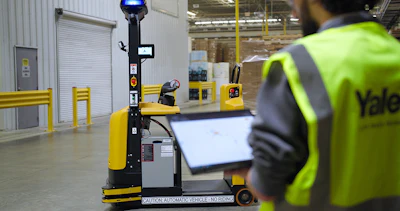
Introducing an automated lift truck into a facility starts with manually operating the truck through the space to establish routes and build a map. Once this data is collected by a single truck, the map can be used not only by that truck but also by all the trucks in the automated fleet.
Trucks automatically follow their programmed routes, using built-in sensors to detect obstacles and obstructions, and communicate information back to the supervisor so the problem can be addressed. Modern, infrastructure-free navigation and intuitive software enable operations to quickly and easily make route changes to balance the flow of traffic and accommodate layout adjustments due to changing inventories and workflows.
Achieving return on investment
By reducing operating costs and improving productivity, automated lift trucks can deliver a relatively quick return on investment (ROI), though that timeline naturally varies by operation. Several variables, such as the number of manual trucks replaced, number of shifts and operating hours and the burdened labor rate, will influence the speed with which an operation can reasonably expect to achieve ROI. The acquisition and payment method, whether automated lift trucks are purchased outright as a capital expenditure or adopted through an operational expenditure model like rentals, leasing or Automation-as-a-Service (AaaS), also influences the time to break even.
In a rental scenario, an automated lift truck deployment can be cashflow positive in as little as one month for certain operations.
Looking to the future
In both the short and long term, automated lift trucks can provide significant cost savings related to labor, injuries, damage and manual equipment fleets. However, ROI is not the only appeal of automation. Many leaders choose automated lift trucks to hedge against long-term labor challenges and promote scalability without labor constraints and volatility. Converting to an autonomous fleet fosters a predictable and productive operation. With the operational benefits and savings achieved through automated lift trucks, companies can focus on business growth and innovation.