The United States still does not have a single, unified federal ESG rule. Instead, sustainability expectations in food logistics are being shaped by several forces at the same time:
● State climate disclosure laws
● State-by-state packaging regulations
● Federal food traceability requirements
The result is a fragmented landscape. But for food manufacturers, distributors, retailers, 3PLs, and cold-chain operators, the takeaway is simple.
ESG is becoming operational.
Progress is no longer coming from new policies or sustainability statements. It is coming from changes in what actually happens at distribution centers and manufacturing plants. In particular, it is coming from yard operations, where emissions, energy use, trailer dwell, refrigeration load, and service reliability converge.
That is why yard electrification, paired with disciplined yard optimization, is moving from an aspiration to a practical compliance and competitiveness strategy.
A quick primer on emissions scopes
Before going further, it helps to clarify how emissions are categorized.
Scope 1
Direct emissions from assets a company owns or controls: In food logistics, this includes fuel burned by on-site equipment such as yard tractors and facility vehicles.
Scope 2
Indirect emissions from purchased energy: This mainly includes electricity used to power warehouses, cold storage, and charging infrastructure.
Scope 3
Indirect emissions across the value chain: This includes transportation providers, third-party logistics partners, suppliers, and downstream distribution. For most food companies, Scope 3 represents the largest share of total emissions.
Many yard operations activities affect more than one scope at the same time. That is why yard operations play such a central role in ESG execution.
Climate disclosure turns inefficiency into reportable emissions
California is leading the most impactful climate disclosure effort affecting U.S. supply chains. Under SB 253, large companies doing business in the state will be required to report greenhouse gas emissions. Scope 1 and Scope 2 reporting begins in 2026, with initial reporting deadlines expected in 2026, followed by Scope 3 reporting starting in 2027 and beyond.
Even as implementation details continue to evolve, the direction is clear. Large food brands and retailers will be expected to produce emissions data that is accurate, defensible, and auditable.
A companion law, SB 261, which would require climate-related financial risk reporting, is currently enjoined and cannot be enforced while legal appeals proceed.
Because Scope 3 emissions often make up the largest portion of a food company’s footprint, suppliers and logistics partners will feel this pressure first through customer requirements.
This is where yard operations become unavoidable.
Trailer dwell, gate congestion, yard tractor idling, and inefficient rehandles are not just operational frustrations. They are emission sources that companies will increasingly be asked to measure and reduce.
Electrification lowers emissions intensity. Optimization determines whether those reductions are real and repeatable.
Reducing emissions while improving performance
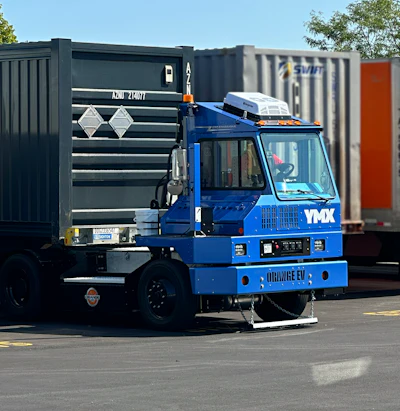
Yard tractor electrification is one of the most direct ways to reduce facility-level fuel use. Diesel yard tractors idle frequently, operate short duty cycles, and remain on fixed campuses. That makes them concentrated sources of Scope 1 emissions.
Replacing diesel units with electric tractors eliminates tailpipe emissions where the work happens. As disclosure expectations tighten, that matters.
But electrification alone does not solve the problem.
In food logistics, the execution of yard operations directly affects transportation flow and cold-chain stability. Congested yards lead to carrier idling, missed appointments, longer trailer waits, and service disruptions. All of these increase emissions and reduce reliability.
Electrification helps. Optimization is what shortens dwell, smooths flow, and restores predictability.
The difference is simple: Electrification changes the equipment. Optimization changes the system.
Yard optimization is the ESG multiplier
A common mistake in sustainability planning is treating electrification as a standalone initiative. If yard operations remain reactive, inefficiencies remain. Excess moves, long dwell times, and congestion continue, even with electric equipment.
Optimized yard operations create measurable ESG benefits by eliminating the conditions that drive waste:
● Shorter dwell reduces refrigeration runtime and energy consumption
● Fewer rehandles reduce total moves and equipment usage
● Smoother gate and dock flow reduces carrier idle time
● Better move sequencing improves electric asset productivity and charging stability
These same operational signals drive service performance. ESG metrics and operational metrics are increasingly the same metrics.
The cold chain increases energy and risk exposure
Food logistics faces additional sustainability pressure because emissions are not limited to fuel. Refrigeration energy use and refrigerant management are under growing scrutiny.
Cold storage facilities already operate with high electricity costs and peak demand risk. When yard operations congestion increases dwell, refrigeration load rises. When yard operations execution forces last-minute reshuffling, doors stay open longer and temperature control becomes harder to maintain.
Electrification adds another variable: charging demand.
Without coordination, charging can increase peak electricity usage and costs. With coordination, it becomes a controllable ESG lever. Successful cold-chain electrification programs treat charging strategy, dwell reduction, and move sequencing as one integrated operating discipline.
Packaging rules turn efficiency into compliance
Extended producer responsibility laws are spreading across the United States. Several states have already enacted comprehensive packaging EPR regulations.
These policies are often discussed as packaging design challenges. In reality, their impact shows up in daily operations. Packaging changes affect pallet density, trailer utilization, damage rates, returns, and waste handling.
Those changes ripple into dock schedules, yard operations flow, and trailer staging.
Optimized yard operations absorb these shifts without creating congestion. They protect throughput and reduce waste as packaging mixes evolve. In this environment, operational efficiency becomes both a sustainability strategy and a margin strategy.
Traceability depends on yard operations discipline
Food traceability requirements are becoming more digital, standardized, and auditable, even as enforcement timelines shift.
The FDA has indicated it does not intend to enforce FSMA 204 before July 20, 2028. The requirements themselves remain unchanged.
Yard operations are often where traceability breaks down. Trailers are staged, reassigned, and moved under time pressure. Handoffs occur across carriers, warehouses, and facilities.
Without consistent operating discipline and visibility, records become fragile.
Electrification does not solve traceability challenges. Operational discipline does. But electrified equipment can support more consistent execution by reducing breakdowns and variability.
Fragmented rules favor standardized operations
The hardest part of ESG in U.S. food logistics is not any single regulation. It is the overlap.
Climate disclosure is being driven by states. Packaging rules vary by region. Traceability is federal. Customer expectations often move faster than regulators.
At the federal level, the SEC has voted to end its defense of its climate disclosure rules, reinforcing that near-term ESG pressure will continue to come from a mix of state regulations and customer requirements.
This creates three practical realities:
● Sustainability data is becoming transactional
● Compliance is increasingly customer-driven
● ESG performance reflects operational performance
In this environment, network-wide standardization becomes the advantage.
When yard electrification and optimization are deployed through a consistent yard operations operating model, ESG improvements become measurable, comparable, and scalable.
What food shippers should do next
For leaders planning 2026 and beyond, the highest-impact moves are straightforward:
● Treat yard electrification as a system change, not an asset purchase. Pair charging strategy with dwell reduction and move sequencing.
● Optimize yard operations flow before scaling across the network. Fix the drivers of rehandles, searches, and congestion so electrification benefits compound.
● Build repeatable, cross-site yard operations discipline. ESG demands consistency in both outcomes and data.
● Connect yard operations data to ESG reporting. Dwell, idle, energy use, and trailer turns are sustainability metrics in operational form.
● Make sustainability resilient to peak conditions. The true test is not a steady week. It is surge volumes, disruptions, and seasonal volatility.
A subtle shift in the role of yard operations
Yard operations have long been treated as a buffer. Today, they are becoming a lever.
Electrification changes the emissions profile of yard work. Optimization determines whether those changes translate into real results. When combined, they shift sustainability from aspiration to execution at the point where food logistics is most exposed to cost, energy, and service risk.
As ESG expectations continue to evolve, the most effective strategies will not be built in reports or frameworks. They will be built into daily operating discipline. For many food supply chains, that work begins with yard operations.