
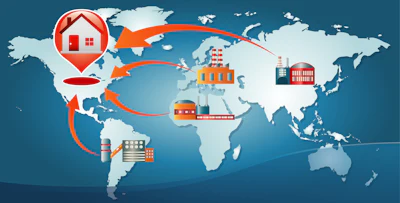
Global supply chains may appear vast and borderless, but they rely on a handful of narrow maritime chokepoints. With nearly 80% of goods transported by ocean, even minor disruptions in these critical corridors can ripple across global trade and economies. For decades, supply chains have been optimized for efficiency by minimizing costs and reducing inventory through just-in-time principles given the stable and predictable flows of freight. But today’s geopolitical tensions, climate volatility, and growing trade complexity are exposing the limits of this model, wherein efficiency is being undermined by the fragility of these critical maritime nodes.
Recent events have highlighted the vulnerabilities of global trade chokepoints. Ongoing tensions in the Strait of Hormuz, which supports 20% of the world’s oil flow and 80% of Asia's energy imports, have driven energy price volatility from approx. $70-120 per barrel. Similarly, the six-day blockage of the Suez Canal by the Ever Given in 2021 showed how a single incident can halt a critical trade artery, disrupting up to $9.6 billion in trade per day.
These disruptions extend far beyond freight delays thereby tightening shipping capacity, driving up freight rates, and creating cascading congestion across ports and logistics networks. Inventory flows become distorted, triggering bullwhip effects, some regions see stockouts while others have excess inventory. There is also a growing sustainability cost, as extended routes increase fuel consumption and emissions, undermining decarbonization efforts. With more than half of global maritime trade routes exposed to these risks, supply chain resilience is essential.
 Nayantara Mehta, CMA CGM North America
Here are six critical maritime chokepoints, their impact on global trade, and the strategies needed to navigate an increasingly uncertain world.
- Strait of Hormuz: World’s energy lifeline
Located between Iran and the UAE - Oman corridor, the Strait of Hormuz, just 21 miles wide at its narrowest, carries nearly 20 million barrels of oil per day and about one-fifth of global LNG trade, with over 80% of these flows destined for Asian markets. Ongoing geopolitical tensions in the region are heightening risks not only to energy markets and oil prices, but also to critical supply chains including other critical commodities such as fertilizers, aluminum, sulphur, methanol, synthetic graphite and helium, which is essential for industries across agriculture, automotive, semiconductors and medical technologies. - Suez Canal and Bab El-Mandeb Strait: Inter-continental trade artery
Spanning 120 miles, the Suez Canal facilitates 12% of global trade and serves as the shortest sea route between Europe and Asia. Over 20,000 vessels had been crossing it annually till 2023 until the Houthi attack. Since then, there has been a 36% reduction with only 12,758 vessels passing through the canal in 2025. This has led to vessel diversion around the Cape of Good Hope, adding 10-21 days to transit times and significantly driving up fuel costs and carbon emission by 41 million tons a year. - South China Sea: Backbone of global manufacturing trade
Connected by key access points such as the Strait of Malacca, this region serves as a primary artery linking Asian manufacturing hubs to global markets with at least $5.3 trillion in goods moving through it annually. However, congestion and escalating geopolitical tensions pose significant risks of potentially disrupting up to 26% of international trade, making it one of the most vulnerable chokepoints in the world. - Panama Canal: Linking the Atlantic and Pacific
Carrying around 5% of global container traffic and nearly 46% of trade between the U.S. East Coast and East Asia, this route helps bypass the lengthy Cape Horn passage, connecting nearly 2,000 ports across 170 countries. However, a severe drought in FY2024 reduced water levels in the canal’s lock system, cutting daily transits from around 36 to 22 vessels. This lowered annual traffic to roughly 10,000, nearly 29% below pre-drought levels while also causing significant vessel delays. Through measures such as water-saving protocols, and optimized reservation systems the daily transit is almost back to normal, facilitating over 13,400 transits in 2025. - English Channel: Europe’s busiest corridor
With over 500 vessels crossing daily, the English Channel is the world’s busiest shipping lane, linking the North Sea to the Atlantic and supporting nearly 95% of the UK’s trade with continental Europe. However, congestion at Port of Dover, Brexit-related checks extending inspection times by approximately 10%, and severe weather-driven navigational delays are intensifying operational pressures across this critical corridor. - Bosphorus Strait: The narrowest artery
Linking the Black Sea to the Marmara Sea, the Bosphorus Strait handles around 50,000 vessel transits annually and 3-4% of global oil flows, despite being just 700 meters wide at its narrowest. Increasing congestion, rising near-miss incidents, and pollution risks have intensified operational challenges, prompting Turkish authorities to implement stricter traffic controls, advanced navigation systems (AIS and VTS), and mandatory pilotage for high-risk vessels to improve safety and maintain efficiency.
Building resilient maritime supply chains
Leading logistics players are moving from reactive responses to proactive resilience frameworks, anchored in a few critical shifts:
● Network diversification is reducing reliance on single routes by enabling multi-corridor supply chains with built-in flexibility. By integrating inland rail, trucking networks, and air freight supported by growing investments in logistics hubs, transloading facilities, depots, and inland container capacity, companies are operationalizing more distributed and adaptive networks.
● AI-driven route optimization and risk prediction using real-time data and predictive analytics across geopolitical, environmental, and operational signals to dynamically reroute shipments and anticipate disruptions before they escalate.
● Digital twin simulation of logistics networks, allowing organizations to model disruption scenarios, stress-test chokepoints, and strengthen contingency planning at scale.
● Sourcing and inventory positioning evolve beyond pure just-in-time models toward selectively buffered storage complemented by nearshoring and regionalization to reduce exposure to single points of failure.
● Government-led visibility and ecosystem collaboration, such as U.S. DOT’s FLOW initiative, enhances supply chain resilience by enabling real-time, end-to-end visibility and data sharing across shippers, ocean carriers, ports, and logistics providers, improving coordination, reducing congestion, and supporting more efficient planning.
● Insurance tech is rapidly expanding, using advanced analytics, parametric models, and real-time risk monitoring to provide coverage for cargo delays and disruptions, giving shippers and forwarders greater control, visibility, and financial protection across their supply chains.
Maritime chokepoints are no longer geographic constraints but strategic levers of global trade stability
For supply chain leaders, the question is no longer if disruption will occur, but when and how prepared their networks are to absorb the shock. In an era defined by geopolitical uncertainty, climate volatility, and rising trade complexity, resilience will not come from avoiding chokepoints, but from intelligently navigating them.







![Top Tech Logo 2026 Vertical [color]](https://img.foodlogistics.com/mindful/acbm/workspaces/default/uploads/2026/04/top-tech-logo-2026-vertical-color.mWl7RAiZmg.png?ar=16%3A9&auto=format%2Ccompress&bg=fff&dpr=2&fill-color=fff&fit=fill&h=135&q=70&w=240)