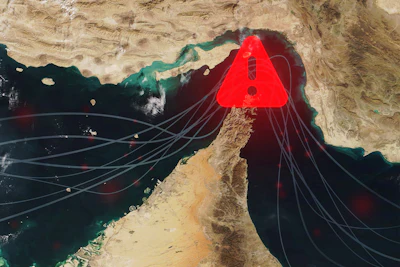
Container shipping faces mounting pressure from geopolitical tensions in the Middle East and Red Sea, with freight rates reaching nine-month highs. A rapid return to Suez Canal routing could paradoxically create new port congestion in Europe as vessels arrive simultaneously, potentially disrupting supply chains through 2026.
- Drewry's World Container Index reached $4,639 per forty-foot container on July 9, the highest since September 2024, driven by Asia-Europe trade route pressures.
- Cape of Good Hope alternative routings add 1-2 weeks to transit times and consume an estimated 2.5 million TEU of global container capacity.
- A full Suez return could release approximately 6% of global fleet capacity into an already saturated market absorbing record newbuild deliveries.
- Rapid Suez normalization risks creating overlapping arrival waves at European ports, potentially spreading congestion inland through rail, trucking, and warehousing networks.
- War risk and emergency surcharges on Gulf-linked routes can reach several thousand dollars per container, with insurance costs at multiples of pre-conflict levels.
Container freight rates have continued to climb into July, with Drewry's World Container Index reaching $4,639 per forty-foot container on July 9, its highest level since September 2024, driven largely by rising rates on Asia-Europe trade routes, according to Sogese’s July Europe Container Market Update.
“The container shipping market is currently affected by a combination of geopolitical instability, strong seasonal demand, capacity constraints and continued uncertainty on key maritime routes. Recent tensions in the Middle East, including violations of the ceasefire involving Iran, the United States and regional actors, have increased risk perception across the Strait of Hormuz, the Red Sea and the Suez Canal corridor,” says Andrea Monti, CEO and managing director of Sogese.
Key takeaways:
· Geopolitical recovery and logistics recovery move at different speeds—and that the gap between them, rather than the conflict alone, could shape freight rates, transit times and port congestion through the second half of 2026.
· The global fleet is growing 5-6% in 2026, yet close to one-fifth of nominal capacity is not effectively available. Cape of Good Hope routings can add 1-2 weeks to transit times on affected services and absorb an estimated 2.5 million TEU of capacity; slow steaming, adopted as bunker costs rose roughly two-thirds after February, and port congestion absorb the rest.
· When the Strait of Hormuz was closed in late February, roughly one-tenth of the global container fleet was affected within weeks, with over 100 vessels sheltering inside the Gulf. Following the June 17 framework, there were indications of a limited increase in traffic through the Strait, but the recovery remained partial and container shipping activity continued to face significant operational and security constraints. Subsequent developments have further underlined the fragility of the situation and the uncertainty surrounding a sustained normalization of traffic.
· On Gulf-linked routings, war risk and emergency surcharges alone can reach several thousand dollars per container. Insurance costs have at times reached multiples of pre-conflict levels.
· The report's central warning concerns the scenario shippers are hoping for a stable Red Sea normalization. While a return to shorter routings could materially reduce Asia-Europe transit times, analysis indicates that the transition itself could create new operational pressures.
· Suez-routed and Cape-routed vessels could reach European ports within compressed arrival windows, creating overlapping arrival waves and increasing the risk of congestion spreading inland through rail, trucking and warehousing networks. The resulting disruption could subsequently contribute to container shortages at Asian origins roughly 8-9 weeks later. A full Suez return would also release around 6% of the global fleet into a market already absorbing record newbuild deliveries.
· For Italy, the report identifies a leveraged position. Carrier network economics under Cape routings have strengthened Gioia Tauro as a Mediterranean transshipment hub, while other gateways inherit greater feeder dependence.
· Italian ports would recover their transit-time advantage over Northern Europe first in a normalization, and could also absorb the effects of congestion first in a disorderly one. The cost of today's unreliability can disproportionately affect Italy's small and mid-sized manufacturers, where transit variability stretches payment cycles, ties up working capital in buffer stock and pushes financing strain onto smaller logistics providers.
· The Red Sea and Suez Canal remain the most important swing factors. A gradual return to Suez could reduce transit times and release effective capacity, but a rapid return could also create congestion in European ports due to compressed arrival windows. A sustained normalization is unlikely to happen immediately and could require a gradual transition as carriers assess security conditions and progressively restore services.
· The Middle East Gulf remains the highest-risk operational area. Services connected to the Strait of Hormuz, UAE, Qatar, Kuwait, Bahrain, Oman, Iraq and Saudi Gulf ports may continue to face additional surcharges, feeder restrictions, alternative routing, landbridge solutions and higher insurance costs.
“For shippers, the priority now is to secure space early, avoid excessive exposure to the spot market, carefully review surcharge structures and build additional buffer into lead times. For logistics operators and carriers, the challenge is to prepare for what comes next. Any eventual return to Suez will need to be managed carefully to avoid turning the recovery itself into a new cycle of congestion, service disruption and sudden rate corrections,” adds Monti.