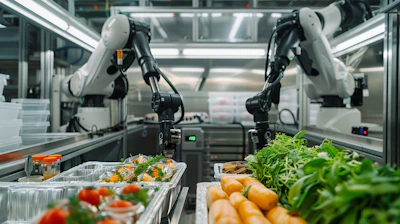
There’s a good argument to be made for automation changing the factory floor faster than the workforce. Walk into any modern food manufacturing plant, and the contrast with even 20 years ago is stark. Lines that once relied on dozens, sometimes hundreds, of people are now run by a small number of operators overseeing highly automated systems. Robotics, sensors, and connected equipment have brought real gains in efficiency, consistency, and food safety. For manufacturers, automation has been a necessary response to margin pressure, rising compliance demands, and the need to produce more with fewer resources. On the surface, it looks like progress – reducing manual effort while raising operational standards.
But beneath that progress there’s a growing tension. As machines have taken on more physical work, the demands placed on the people who remain have increased sharply. Automation hasn’t removed the human element from the factory floor; it has simply changed it. Today’s plants depend on a much smaller number of individuals whose decisions, judgment, and technical capability carry far more weight than before. When something goes wrong, the issue is rarely a mechanical failure in need of a quick fix. It’s more likely to involve software, connectivity, data flows, or the interaction between systems. The pace of technological change has outpaced the evolution of skills, and that gap is becoming one of the most significant operational risks facing food manufacturers today.
From wrenches to laptops
Maintenance in food manufacturing was traditionally rooted in mechanical know-how. When a line stopped, the fix usually involved physical inspection, replacement parts, and hands-on repair. That knowledge still matters, but it’s no longer enough on its own. Today’s equipment is deeply interconnected, with programmable logic controllers, sensors, vision systems, and networks working together to keep production moving. Diagnosing a fault increasingly means connecting a laptop, reviewing logs, and understanding how software and hardware interact across the line. In other words, the work has shifted from purely physical to digital problem-solving, often under intense time pressure.
This has raised the bar for the people responsible for keeping plants running. A modern technician needs to understand mechanics, electronics, and digital systems in equal measure, yet the pool of workers with that combined skillset is limited, and traditional hiring searches have not scaled appropriately. When those skills are missing, even minor issues can lead to extended downtime because the problem isn’t obvious or easily isolated, or traditional wrench turning compounds the issue. In highly automated environments, there is less slack built into the system, and fewer people on the floor to catch or compensate for failures. That makes the knowledge held by each technician more critical than ever, and it explains why gaps in digital capability translate directly into lost productivity, higher risk, and slower recovery when things go wrong.
When talent crunch meets business crunch
As automation has reshaped roles on the factory floor, it’s also reshaped the challenge of hiring and keeping the right people. Food manufacturers that once looked for operators and mechanics are now looking for individuals who are comfortable working across both physical equipment and digital systems. That puts the industry in direct competition with sectors that already present themselves as technology-first employers, even though food production environments can be just as complex. What we’re seeing now is a persistent struggle to attract and retain the kind of hybrid talent modern plants now depend on.
It doesn’t help that the impact of that shortage is now being amplified by how lean today’s operations have become. With fewer people running each line, the loss of a single experienced technician or engineer can leave a noticeable gap in capability. Knowledge that once might have been spread across a large team is now concentrated in a handful of individuals, and when those people leave, retire, or are simply unavailable, plants become more vulnerable to disruption. Automation may reduce headcount, but it increases dependency on the skills of those who remain, turning the talent gap into a direct constraint on reliability, resilience, and growth. Automation is often touted as replacing people, but it often just creates more dependencies on key employees.
Data-rich, insight-poor
The skills gap doesn’t stop with maintenance teams either. Plant managers, quality leaders, and operations teams are now surrounded by more data than ever, generated by automated equipment, quality systems, and connected sensors across the facility. These tools might promise greater visibility and tighter control, but only if the data they produce can be understood and acted on. In many plants, that capability hasn’t kept pace with the technology itself. Leaders who are highly experienced in running physical operations are often expected to make decisions based on dashboards, trend reports, and alerts they were never formally trained to interpret.
When data isn’t translated into clear, operational insight, it becomes little more than background noise, and likely forgotten. Systems still collect information, audits still get completed, and boxes still get ticked, but the opportunity to spot early warning signs or drive continuous improvement is completely missed. In that sense, instead of supporting better decisions, technology can end up adding complexity and requiring even more cognitive input from the humans in the room. The real value of automation and digital systems is only unlocked when data is directly connected to action on the plant floor. Without the skills to do that consistently, even well-intentioned investments in automation and AI struggle to deliver meaningful performance gains. It’s not enough to jump on the AI bandwagon; companies also need to learn how to drive it.
The humans in the loop
Automation has changed what food manufacturing looks like, but it hasn’t changed what it ultimately depends on. Machines can move faster, measure more precisely, and operate around the clock, but they still rely on people to keep them running, interpret what they’re telling us, and intervene when conditions change. As plants become more automated and more connected, the cost of skill gaps rises. Downtime lasts longer, risks are harder to spot, and opportunities for improvement are easier to miss. Closing the food factory skills gap means recognizing that investment in technology and investment in people simply can’t be separated. Digital systems only deliver value when the workforce has the confidence and capability to use them effectively. For manufacturers, the next phase of competitiveness won’t be defined solely by how advanced their equipment is, but by how well they equip their teams to operate at the intersection of physical production and digital intelligence.