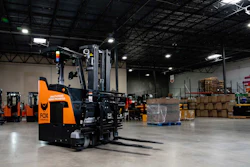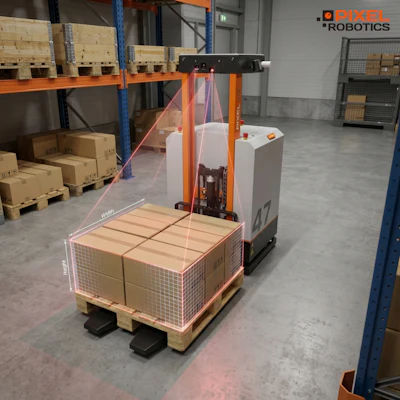
Pixel Robotics GmbH presented Pixel PT, an AI-powered pallet transporter that combines state-of-the-art technology with application-driven AI to make material flows more efficient, safer and more flexible.
Key takeaways:
· The Pixel PT can detect the height of a picked-up pallet and use this data for volume optimization in outbound logistics.
· The measured values can also be considered in tour planning: large pallets can be sent directly to the dock, while smaller pallets can first be routed to a consolidation stage.
· The addition of an MCP server (Model Context Protocol) allows integration with leading large language models and enables users to perform evaluations and analyses in natural language.
· The Pixel PT can now, with its cantilever fork, also swing over or under conveyor technology, significantly reducing the required space.
· The Pixel PT’s AI-based object detection recognizes the hanging foil as foil (even within the safety field) — and not as a safety-relevant object (such as a person’s foot) — and continues its movement without compromising safety or efficiency.
· Thanks to camera-based AI, the robot reliably detects forklift forks and adapts to rough floor.
· Pallets can be picked up regardless of their position or slight deviations.
· The AI differentiates between foil and solid obstacles, ensuring smooth pallet handling, even for pallets wrapped to the ground.
· Pallets are placed pragmatically and adaptively, just like a forklift operator would do.
· The Pixel PT identifies people, vehicles, and both moving and stationary obstacles, responding with remarkable flexibility.
· Using a digital twin of the operational area, Pixel Robotics enables seamless collaboration between humans and machines without the need for adjustments to existing processes and without the need for WMS integration.