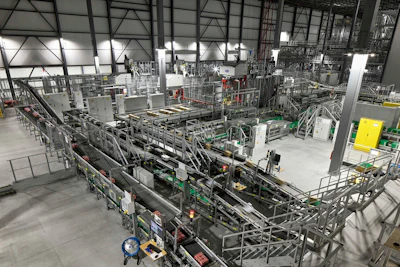
Automation is on the rise across every sector. Shifting consumer expectations, labor shortages, supply chain efficiency demands and other factors have made traditional, human-centered warehousing and material handling models increasingly unsustainable.
Food and beverage companies are among the leading adopters of warehouse automation technology. However, automating grocery warehousing operations presents some unique challenges: from perishability and sanitation to maintaining order accuracy across ambient, refrigerated and frozen storage environments. Meanwhile, omnichannel grocery demand is compressing fulfillment windows and increasing SKU variability.
Automation promises speed, precision and scalability in the face of these challenges. But in automated warehouses, your system’s performance depends on the containers moving through it.
Moving from human hands to machine tolerances
Many food and grocery warehouses start the automation process hoping their existing corrugate or legacy totes can be simply dropped into the new system. Unfortunately, that’s just not the case.
Automated storage and retrieval systems (AS/RS) run on consistency. In human-driven, manual material-handling operations, containers might be treated as a commodity. In today’s highly automated environments, they’re essential infrastructure. That’s because even the most advanced AS/RS technologies operate under extremely tight tolerances. So, while a human can handle a 10-millimeter container bulge without blinking, that same variance could disrupt your entire automated operation.
Container design is one of the first steps in any successful AS/RS implementation recipe. Before selecting the packaging for your new system, take a close look at the SKUs it needs to handle. The range of product weights and dimensions moving through a warehouse should inform the size, structure and characteristics of your containers.
There are three key tolerances to consider when it comes to automated food warehouse packaging design:
1. Sidewall bulge limits: Even minor sidewall distortion can disrupt conveyor guides, AS/RS shuttle clearance and robotic gripping precision. Bulging beyond millimeter tolerances can trigger jams, misreads or system stoppages.
2. Bottom deflection under load: Reliable base rigidity ensures stable transport, lift engagement and stacking alignment. Deflection can compromise picking accuracy and put unnecessary stress on automation components.
3. Stack integrity over time: Fast-cycle food operations often stack containers repeatedly. If structural integrity degrades, vertical compression can affect depalletizing, robotic retrieval and storage density, leading to long-term inefficiencies.
Along with these factors, production consistency is key. Before partnering with an automation packaging manufacturer, ask about their quality control and assurance process. Dimensional variations within or between production runs can disrupt everything from sensor calibration to barcode alignment.
Automated warehouse systems rarely fail due to flawed robotics. The biggest challenge to any successful automation implementation is engineering your packaging infrastructure to align with the mechanical realities of your system.
That can be especially difficult in the food and beverage sector where there are a few additional factors influencing container design.
Designing containers for food-safe environments
On top of those key tolerances, food and grocery containers must meet safety and regulatory requirements. There are a few compliance-related factors that can have a big impact as you balance design features and tolerances:
Sanitation
Whether running a direct-contact or no-contact operation, maintaining clean containers and preventing cross-contamination is essential. That means providing a smooth internal surface that won’t trap dirt, debris or moisture. Structural features like ribbing and welded bases are a great way to add strength and rigidity to containers, but they also create critical points of failure where bacteria and pathogens might thrive.
Talk with a packaging provider about your washdown process. Depending on the container materials, prolonged or repeated chemical exposure and drastic temperature swings can compromise surface and dimensional integrity over time. Flow-through is important here, so remember to incorporate drainage in strategic areas. Just be sure to position drainage holes where they won’t interfere with your system’s sensors and conveyors.
Temperature
Depending on the scope of your operation, food and grocery warehousing facilities can have up to four distinct temperature zones:
· Ambient
· Refrigerated (45-56°F)
· Protein (33-36°F)
· Frozen (-10°F)
Plastic contracts at colder temperatures and expands in warmer environments, so these zones influence everything from material selection to operational best practices. For instance, high-density polyethylene (HDPE) is one of the most durable materials at low temperatures, but its deflection point isn’t ideal for automated storage. On the other hand, copolymer polypropylene limits deflection, but becomes a liability in the freezer.
Talk with a packaging manufacturer to determine the right materials for your operation. Selecting a single material for all containers will help ensure consistency throughout the system but might result in performance variations across zones.
Operational discipline is just as important as material selection. Whatever material(s) you select, be sure to keep containers within their assigned zones to limit dimensional drift over time.
Traceability
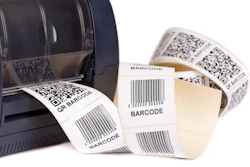
When it comes to an AS/RS, barcodes are so much more than just labels. They’re the driving force behind the containers in an automated warehouse, providing a detailed, real-time picture of inventory as it moves through the fulfillment process.
There are a couple of common methods for applying barcodes to containers. The first uses a pulse-mold adhesive to attach the barcode to existing packaging. This cost-effective approach has some drawbacks: since the container substrate and label material contract and expand at different rates, the adhesive can lose its grip over time, leading to label lift, wrinkling, or misreads. In-mold labelling (IML) on the other hand, integrates the barcode directly into the plastic wall of your packaging, significantly reducing risk of failure.
Traceability is especially important for risk mitigation in food warehousing operations. In addition to inventory transparency, the right container design should strengthen your food safety controls. By helping identify root causes sooner and quickly tracking cross-contamination vectors, traceable containers can limit the scope and impact of potentially costly recalls.
For some operations, that might mean going beyond the barcode and incorporating RFID technologies to help track inventory across your entire distribution footprint.
Packaging in the age of automation
Automation is transforming the food and grocery warehousing landscape. The promise of increased speed and labor reduction is real. But as systems speed up, tolerances tighten. Realizing the benefits of automation requires dimensional precision, temperature stability, sanitation assurance and data-driven design.
Warehouse automation projects can cost millions of dollars, yet the containers that drive these complex systems are often specified last. That mistake could delay or derail your entire project. Depending on the unique needs of an operation, custom containers may require lead times of up to six months to engineer and produce.
That’s why it’s important to choose a packaging manufacturer with experience in the food and grocery space and bring them into the process early. Containers are no longer generic consumables. They’re a key component of your capital infrastructure. The right partner will help navigate the complexities of container design from initial planning through final delivery. Because packaging in the age of automation is the essential foundation for warehousing success.