Supply chain leaders have spent years building visibility across transportation, inventory, warehousing and procurement. Artificial intelligence, predictive analytics, control towers and digital twins are now expanding what organizations can see, forecast and automate.
The University of Tennessee’s Global Supply Chain Institute reinforced that direction: AI is moving into operational work, reliable data remains essential, and resilience has become an everyday capability rather than a contingency plan.
For food and beverage supply chains, however, the defining question is no longer whether more information is available. It is whether the organization can act on that information quickly enough to protect product, maintain service and keep freight moving.
Nowhere is that challenge more visible than in the yard, where production schedules, transportation plans, warehouse priorities, labor, equipment and customer commitments meet real world execution.
Yard operations are moving from tactical to strategic, fragmented to orchestrated, reactive to predictive, and manual to increasingly autonomous. The next competitive advantage will come from the intersection of technology and execution.
Visibility does not protect the product
Food logistics leaves little room for delayed decisions. Products may be perishable. Temperature requirements must be maintained. Production, labor and transportation schedules are tightly connected.
A late inbound load can disrupt manufacturing. A missed trailer move can leave a receiving team waiting. A delayed outbound shipment can reduce remaining shelf life or affect an on-time, in-full commitment.
With visibility tools, organizations can increasingly see these problems: a late truck, a congested gate, an occupied dock door, rising dwell time or an inventory exception. However, what remains difficult is coordinating the optimal response.
Knowing that a temperature-sensitive trailer is at risk does not determine which load should be prioritized, where the trailer should be staged, whether a door can be reassigned, who can approve the change or how the decision affects the rest of the facility.
The FDA’s sanitary transportation rule underscores the importance of appropriate equipment, operating practices, training, records and coordination among shippers, loaders, carriers and receivers. For products requiring temperature control for safety, the physical response matters as much as the receiving the alert.
The distance between identifying an issue and completing the response is the execution gap. In food logistics, that gap can quickly become a cost, service or product-integrity problem.
AI is becoming a decision engine
Much of the conversation around artificial intelligence focuses on automating existing tasks and processes. However, the larger opportunity may be its ability to improve and accelerate decision-making.
AI can analyze more information than individuals or teams can consistently process in real time. It can identify patterns, predict constraints and recommend the next best action.
In a food distribution network, that could mean anticipating dock congestion, forecasting labor and equipment requirements, prioritizing time-sensitive loads or recognizing when a schedule is becoming unworkable.
But an intelligent recommendation creates value only when the operation can execute it.
AI-based applications cannot compensate for unreliable data, inconsistent processes, unclear ownership or disconnected systems. It cannot make equipment available, create staging capacity or align teams working toward competing priorities. When the operation is not ready to respond, faster insights only reveal problems faster.
A digital transformation must therefore include the operating model, not just the enabling technology. Organizations need to define the decisions they want to improve, the data required, the people authorized to act and the processes that turn a recommendation into a completed task.
Strategy meets reality in the yard
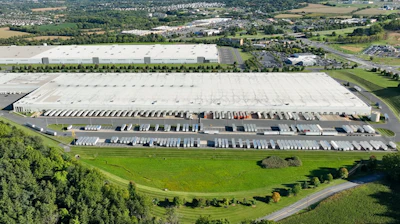
Every food supply chain strategy eventually arrives at a gate or loading dock. Production plans, delivery schedules, inventory priorities, labor, customer commitments and food safety requirements all converge between transportation and warehousing.
When the yard performs well, trailers reach the right locations, dock teams receive the loads they need, drivers move efficiently, and transportation and warehouse plans remain synchronized.
When execution breaks down, drivers wait, yard trucks make unnecessary moves, assets go underutilized, labor is reassigned reactively, reefer trailers require additional monitoring, appointments fall behind, and exceptions compete for limited resources.
Despite their strategic role, many yards are still managed as separate logistics functions. Appointment scheduling, gate management, trailer inventory, spotting, dock execution and carrier communication may be owned by different teams and supported by different systems.
Each function may see its own work without anyone coordinating the complete flow from appointment to departure. That fragmentation is increasingly incompatible with the speed and complexity of food logistics.
Moving from visibility to orchestration
The organizations pulling ahead are moving beyond monitoring fragmented activities and building operating models that coordinate them.
Orchestration connects people, processes, assets, technology and data around a shared business outcome. It establishes how work should flow, how resources should be prioritized, who owns each decision and how teams respond when conditions differ from the plan.
Consider a reefer trailer arriving early whose assigned door remains occupied. Technology may register the arrival, identify the trailer and display the dock status.
But an orchestrated operation goes further. It considers product and temperature requirements, yard capacity, power connections, labor and equipment availability, remaining appointments and risk to other loads. It guides the response and communicates it across the gate, yard, dock, transportation and receiving teams.
This is the shift from visibility to execution: not simply knowing what is happening, but coordinating what happens next.
The objective is not to remove human judgment. It is to give teams a consistent framework and better intelligence so they can make decisions faster, manage exceptions more effectively and execute with less variability.
Building toward autonomous execution
Autonomous operations are often described through autonomous vehicles, artificial intelligence or robotics. Those technologies matter, but autonomy is ultimately an operating capability.
An autonomous operating model senses conditions, analyzes changes, predicts constraints, recommends or initiates actions, and measures the results.
People remain essential — particularly for safety, judgment, customer priorities and complex exceptions. Their work becomes more focused because the operating model provides clearer information, consistent processes and faster coordination.
For food logistics leaders, the path toward autonomy does not start with removing people. It starts with making the operation ready for intelligent decision-making.
Processes must be standardized enough to automate. Data must be accurate enough to trust. Systems must be connected enough to provide context. Responsibilities must be clear enough to support timely action. Performance must be measured across the complete flow rather than within departmental silos.
These foundations allow AI, predictive analytics, computer vision and digital twins to move beyond dashboards and pilots and improve daily execution.
Execution is the new differentiator
Food supply chains will continue to face changing demand, labor constraints, transportation volatility, regulatory requirements and rising customer expectations. More data will help organizations understand that complexity, but information alone will not determine who performs best.
The advantage will belong to organizations that can convert insight into coordinated action.
That means connecting planning with execution and managing transportation, the gate, yard, dock and warehouse as interdependent parts of one flow. It means designing an operating model in which people, processes, assets, technology and data work together rather than in parallel.
Technology creates possibilities. Execution turns those possibilities into improved throughput, lower dwell, stronger service, better asset utilization and greater protection for temperature-sensitive products.
The big shift is already underway for many food and cold chain organizations. Yard operations have evolved from a reactive environment focused on assets and labor into an integrated operating system driven by continuous optimization and improvement.