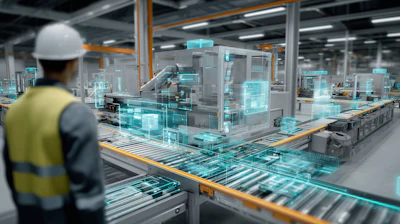
Warehouse operators are under pressure to move more product, serve customers faster, maintain accurate inventory, meet stricter regulations, and keep costs under control despite labor shortages. It’s no surprise the industry conversation often turns to automation, robotics and autonomous equipment. Those tools can help, but they only deliver real value when they are supported by reliable systems and accurate data.
The most important warehouse management tool isn’t necessarily the newest robot or piece of material handling equipment, but rather the technology infrastructure that provides visibility, accurate data, and control over warehouse operations. Without that foundation, even the most advanced automation investments struggle to pay off.
Today's warehouse leaders must focus on tools that help them improve inventory accuracy, reduce unnecessary labor, and make better operational decisions. The goal isn’t adopting new technology for its own sake, but rather deploying technology that solves specific business problems and strengthens the fundamentals that drive warehouse performance.
The biggest challenge isn't labor cost. It's labor efficiency.
One of the most common misconceptions in warehousing is that labor challenges are primarily driven by wage rates. More often, the real issue is the number of hours it takes to get the work done. Warehouse operations remain physically demanding, turnover can be high, and labor markets continue to be competitive. So, cutting unnecessary hours typically delivers more long-term value than chasing lower hourly wages.
This is where warehouse management tools show their real value. Modern warehouse management systems (WMS) help operators identify inefficiencies, optimize workflows, and better allocate labor resources. Real-time visibility into inventory, task assignments and throughput allows managers to deploy associates where they create the most value.
When operators have confidence in their inventory data and workflows, they spend less time searching for product, chasing down discrepancies or redoing work because of errors. Every minute saved contributes to improved productivity and stronger service levels.
Inventory accuracy is the foundation
As warehouses become denser and handle a wider variety of products, maintaining inventory accuracy becomes increasingly difficult. Still, inventory truth remains one of the most important measures of operational success. A counting error is not merely an inventory issue – it can become a customer service failure, a compliance problem or, in food-grade environments, a food-safety risk.
Modern warehouse management tools help address this challenge by combining automated data collection, real-time inventory tracking, and exception management capabilities. Instead of relying exclusively on manual counts, warehouses can leverage technologies that continuously verify inventory data and catch discrepancies before they grow into bigger issues.
Rather than requiring associates to operate lifts and manually count inventory stored at height, automated systems can travel warehouse racking, capture product and location information, and reconcile that data against the WMS. The technology flags exceptions and directs people to investigate specific issues instead of having them search for hours. This lets counts happen more often, improves accuracy and frees up labor for work that actually requires human judgment and decision-making. Just as important, the approach reduces the need for employees to work off lifts or at height, creating a safer environment.
Automation works best when it’s guided by data
Much of the discussion around warehouse innovation focuses on autonomous mobile robots, automated storage and retrieval systems, robotic palletizing, and other advanced technologies. Deployed well, these can deliver real benefits — less walking time, higher storage density, better picking accuracy and fewer associates doing physically demanding tasks. However, organizations often treat automation as a strategy rather than a tool.
The most successful automation programs start with good data. Warehouse management platforms help operators identify where labor hours, operational risk, and inventory errors are high, so they can put technology dollars where they’ll have the greatest impact.
The objective should never be to automate for automation's sake. Warehouse management tools should help leaders understand which processes are creating bottlenecks, consuming excessive labor, or generating preventable errors. From there, automation can be applied where it’s most needed. Technology should earn its place by solving a defined problem, not just claiming to be innovative.
Why many technology deployments fall short
One reason warehouse technology projects fail: organizations underestimate the importance of implementation. In many cases, the technology itself works exactly as intended but the operators are trying to automate inefficient processes or poor data practices. As the saying goes, automation amplifies what already exists. If inventory records are wrong or slotting processes are inconsistent, automating the workflows may make things worse.
Successful deployments begin with a clear understanding of the process being improved. Operators should establish baseline performance metrics before introducing new tools and know the results they’re expecting. Without a clear "before," they will struggle to quantify the "after."
Governance also matters. Warehouse leaders need defined standards, disciplined processes, and ongoing measurements to ensure that operations continue to align with documented procedures. Warehouse management tools provide the visibility needed to maintain this discipline by building accountability through reporting, flagging deviations, and supporting continuous improvement efforts across the operation.
The future of warehouse management
As regulations evolve and customer expectations increase, warehouse operators will continue investing in technology. For food-grade and temperature-controlled environments, that spending must also account for traceability, sanitation standards, and environmental controls. Those considerations make technology evaluation even more important.
The warehouses that pull ahead over the next decade will not necessarily be the ones with the biggest automation budgets. They will be the organizations that build disciplined operating systems supported by accurate data, strong governance, and meaningful measurement. Automation and advanced equipment will remain valuable, but only when part of a broader operational strategy.
At its core, warehouse management technology should help operators strengthen the fundamentals: inventory accuracy, safety, service performance, and operational resilience. When deployed thoughtfully, these tools create safer workplaces, reduce demanding tasks, and allow workers to contribute in more skilled and impactful ways.
The future of warehousing is not about creating dark warehouses run entirely by machines. It’s about smarter warehouses where technology and people work together to deliver higher accuracy, efficiency, and customer service. That’s where the greatest gains and long-term value will come from.