
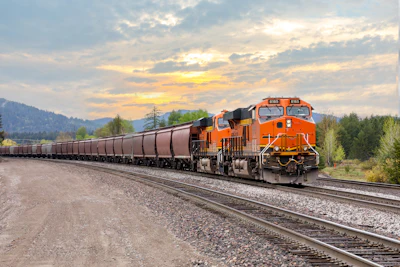
The Railway Safety Act, reintroduced in the U.S. Senate earlier this year, aims to strengthen rail safety, improve inspection protocols, and increase penalties for violations up to $10 million following major derailments. Key provisions include mandatory defect detectors, minimum two-person crews, enhanced hazardous material reporting, and support for first responders
However, this Act would also impose billions of dollars in compliance costs on an industry already operating at its safest point in history, while threatening the innovation that helped produce those gains, according to a new issue brief from the International Center for Law & Economics (ICLE).
“American freight railroads are safer today than at any point in their history,” says ICLE director of innovation policy Kristian Stout. “Train accident rates are down by more than 38% since 2005, hazmat-release rates have fallen by at least 61%, and employee on-duty fatalities recently hit an all-time low. That progress was driven by private investment and innovation under the existing regulatory framework. The right policy response is to sustain that trajectory, not layer on prescriptive mandates that risk reversing it.”
Stout argues that the bill would mandate rulemakings without cost-benefit analysis, lock in current-generation technology, and impose high-profile requirements without a clear basis.
The brief recommends setting measurable safety targets—such as derailments per million train-miles, hazmat-release rates, and bearing-failure rates—while allowing railroads flexibility to determine how best to meet them.
Meanwhile, Association of American Railroads (AAR) and its member railroads urge policymakers to continue refining the legislation to ensure the bill is focused on solution-driven polices that will measurably enhance safety.
“Committee negotiations on the Rail Safety Act have yielded substantive improvements that advance stakeholders’ shared goal, enhancing rail safety, supporting first responders and keeping our communities safe,” says AAR president and CEO Ian Jefferies. “Railroads support items of this bill and remain fully committed to working with the Committee and all members of the Senate to build on these improvements, with the ultimate goal of ensuring all provisions result in meaningful data-driven safety advancements that all can support.”
“At the same time, challenges remain with certain provisions, including those that mandate crew staffing models, expand hazmat transportation operating requirements, micromanage detector networks, and unnecessarily broaden manual inspections. In a piece of safety legislation, each provision should be clearly designed to rectify a current safety challenge. As reported out of the Committee, this bill falls short of that goal. That said, while railroads continue to advance industry-wide safety commitments, AAR and its members will continue to work with Congress to address the remaining obstacles and advance smart policies,” adds Jefferies.
For its part, the Department of Transportation’s Federal Railroad Administration (FRA) has repeatedly concluded that there is not “reliable or conclusive statistical data” showing that “multiple-person crew operations” are any safer than one-person crew operations. And, while costs would increase under this policy, safety outcomes would still not improve.







![Top Tech Logo 2026 Vertical [color]](https://img.foodlogistics.com/mindful/acbm/workspaces/default/uploads/2026/04/top-tech-logo-2026-vertical-color.mWl7RAiZmg.png?ar=16%3A9&auto=format%2Ccompress&bg=fff&dpr=2&fill-color=fff&fit=fill&h=135&q=70&w=240)


