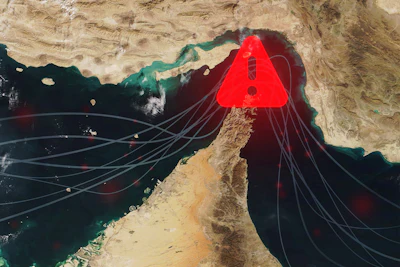
Diversions through the Strait of Hormuz dropped to a 14-week low of 2,721 shipments in week 24, declining 41% since week 20, but this relief has shifted supply chain pressure to major global ports like Navi Mumbai, Mersin, Iskenderun, and Singapore, which are now experiencing record congestion levels.
- Weekly diversions through Hormuz fell to 2,721 shipments in week 24, the lowest in 14 weeks and marking the fourth consecutive weekly decline
- Diversion volumes have dropped 41% since week 20, with the UAE's share of diverted shipments falling from 75% to just over 50%
- Port congestion has reached record highs at five strategic hubs: Navi Mumbai import dwell at 25.4 days, Mersin at 32.2 days, Iskenderun at 22.2 days, and Abu Dhabi export dwell at 53+ days
- Most diversion activity is short-haul repositioning within the Gulf rather than long-haul rerouting, with the Salalah-to-Navi Mumbai lane accounting for roughly 9% of diverted volume
- Air cargo routing through Middle East airports has structurally shifted, with Dubai ceding share to Istanbul and Frankfurt, suggesting permanent changes to global air logistics patterns
Week 24 of the Strait of Hormuz closure showed positive signs on diversion count.
Total weekly diversions through the Strait of Hormuz corridor dropped to 2,721 shipments in week 24, the lowest level in 14 weeks. The decline isn’t a one-week blip: volume has been sliding steadily since week 20, down 41% over that span.
Week 24 marks the fourth straight weekly decline and the low point of the current Active Conflict 2 phase, which began in early July, according to the latest data released by project44.
“Taken together, Week 24’s sea and air data point to the same underlying story from two different angles: less traffic is routing through Gulf infrastructure overall, and lower diversions is a positive signal for vessels moving thought the strait. But the pressure has to show up somewhere. Congestion is continuing to build at record levels for our dataset strategic ports, with Navi Mumbai, Mersin, Iskenderun, and Singapore for import dwell and Abu Dhabi for export dwell. Air cargo data shows Dubai has ceded share to Istanbul and Frankfurt, perhaps permanently,” the study says. “For shippers and carriers, that combination argues for planning around specific hubs and lanes, bracing for extreme delays and potential fees at major ports absorbing the regions traffic. Lower diversions does not mean risk is reduced as a result of Hormuz, only that the pressure from this crisis is showing up elsewhere across the global supply chain.”
Key takeaways:
· The UAE has been the largest single origin country for diverted shipments every week since the crisis began, though its Week 24 volume is roughly one-fifth of what it was in Week 1. Its share of total weekly diversions has fallen from about 75% in Week 1 to just over 50% in Week 24. Saudi Arabia and Oman have each held a fairly steady second and third position across the last eight weeks, while Qatar’s volumes remain a small fraction of the other three by comparison.
· Top 4 origin countries by diverted shipments (UAE) accounted for about 49% of diverted volume, followed by Saudi Arabia at 34%, Oman at 16%, and Qatar just over 1%.
· Rather than long-haul re-routing, most of Week 24’s heaviest diversion activity is short-haul repositioning within and around the Gulf. The single busiest lane, Salalah (Oman) to Navi Mumbai (India), accounts for roughly 9% of the week’s diverted volume. Three of the next four busiest lanes are UAE-internal shuffles between Fujairah, Khawr Fakkan, and Khalifa, and a fourth links Saudi Arabia’s King Abdullah Port to Khawr Fakkan.
· Five ports are driving this week’s dwell story, each seeing new highs in our dataset. Navi Mumbai’s import dwell climbed to 25.4 days, 6 times the pre-conflict baseline. Navi Mumbai has seen consistent import dwell increases through the crisis. Two notable Turkish ports that act as Mediterranean gateways of Middle-East bound trade are experiencing significant port congestion. Mersin, Turkey’s leading gateway to the Middle East, hit records on two fronts at once: import dwell climbed to 32.2 days and transshipment dwell reached 30.8 days, both the highest points since the crisis began. Iskenderun, one of the Top 10 ports in Turkey by TEU volume seen as a potential alternative to Mersin, is now seeing 22.2 days of import dwell, an increase of 10 days in the last month. Singapore is has seen import dwell spike by 4 days in the last month and is now experiencing nearly 11 days of import dwell. On export dwell, Abu Dhabi has experienced elevated export dwell since the crisis began, but Week 24 saw a new high for the crisis at over 53 days.
· From January through mid-August, the share of air shipments routed through a Middle East airport as their first stop fell sharply once the conflict began, and never recovered to where it started. The pattern holds in every phase measured since: potentially representing like a structural change in Gulf air routing, not a temporary dip.