Slip Robotics announced SlipLift, a new platform designed to extend autonomous trailer loading and unloading beyond short-haul, high-frequency routes to heavier freight, regional distribution, and last-mile delivery applications such as food and beverage, packaging and paper products, and dense automotive assemblies.
“We’ve always focused on removing uncertainty at the dock,” says Chris Smith, CEO of Slip Robotics. “SlipLift extends that philosophy. Customers get fast, repeatable load and unload times across more routes, without adding robots or complexity.”
“We kept hearing the same thing from customers,” says Smith. “They wanted the same fast, predictable dock turns we deliver today, but for heavier freight and more routes. SlipLift came directly out of those conversations—it’s about meeting customers where their operations actually are.”
Key takeaways:
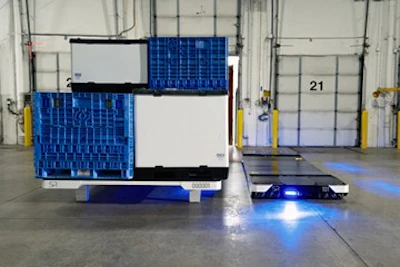
· SlipLift is a core architectural shift that decouples the robot from the payload. This approach delivers SlipBot-level speed, safety, and labor savings while allowing fewer robots to cover more docks, resulting in faster and more predictable dock operations.
· SlipLift supports payloads up to 20,000 pounds, enabling automation for heavier freight while maintaining fast, consistent dock turns.
· SlipLift operates through a simple, repeatable workflow. A SlipLift picks up a loaded SlipCarrier from the dock, autonomously places it inside a trailer or box truck, and exits before repeating the process until the load is complete. Operators remain outside the trailer using a handheld controller, while the robot handles navigation, alignment, and placement.
“Pre-staging changes the economics of last-mile loading,” says Lauren Marneni, head of product at Slip Robotics. “When freight is ready on a SlipCarrier, loading becomes a quick, repeatable process instead of a daily scramble.”
“Our goal was to make autonomy feel natural for operators,” adds Marneni. “The operator stays in control, but the robot does the hard, dangerous work inside the trailer. That’s how you improve safety without slowing things down.”