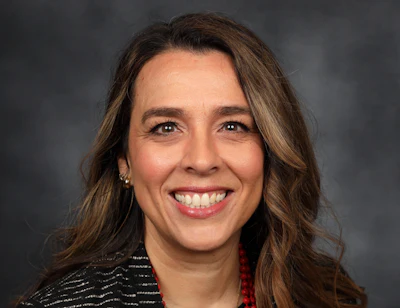
Melanie Sandlin serves as Lazer Logistics' first chief information officer, leading the technology vision and strategy.
Her day-to-day work centers on overseeing the enterprise-wide deployment and optimization of Lazer Logistics Operating System (LLOS) across more than 800 sites, powering over 3,000 connected trucks generating 300 million data points daily.
Sandlin translates operational requirements from yard and logistics teams into technology solutions that drive measurable performance improvements. She leads IT strategy and digital transformation initiatives that align with Lazer's core mission to move businesses and people forward through precise, efficient yard logistics.
Additionally, she partners with cross-service leadership at Lazer to ensure technology enables operational excellence without replacing the people who execute the work.
And, she's leading the expansion of Uncle Phil AI, Lazer's operational coaching intelligence embedded within LLOS, to ensure operational excellence can be consistently delivered regardless of location, customer, or individual experience level.
Previously, she spent 21 years at Cummins, Inc., serving as an information technology executive, where she developed deep expertise in technology leadership within a global manufacturing and logistics environment. She then advanced to become VP, Americas IT at Allegion PLC, expanding her experience across a larger, more complex operational footprint and managing multi-regional IT strategy.
Sandlin was named a winner of this year’s Women in Supply Chain Forum™ award, presented by Food Logistics and Supply & Demand Chain Executive, in the Trailblazers category.
Marina Mayer, editor-in-chief of Food Logistics and Supply & Demand Chain Executive and co-founder of the Women in Supply Chain Forum™, sat down with Sandlin to discuss yard management in an AI world and why retention and development follow the same logic.
Food Logistics and Supply & Demand Chain Executive: Your day-to-day work centers on overseeing the enterprise-wide deployment and optimization of Lazer Logistics Operating System across more than 800 sites, powering over 3,000 connected trucks generating 300 million data points daily. What is the Lazer Logistics Operating System?
Melanie Sandlin: LLOS, the Lazer Logistics Operating System, is the foundation running underneath everything we do in the yard. It is the proprietary digital platform that ties together yard activity, safety, labor, assets, and workflows into one connected view of what's actually happening at a site, in real time. NexusYMS, LazerVision, Uncle Phil AI, and our in-cab safety tools all run on top of LLOS. LLOS is the single pane of glass experience, helping our Site Managers navigate their day.
Today LLOS takes signals from over 3,000 connected trucks, generating roughly 300 million data points every day. That scale only matters because of what it produces: the same standardized process whether you're at the yard we opened this year or the one we've run for a decade, real-time visibility into where a trailer is and where a truck needs maintenance, and accountability that used to depend on someone noticing a problem after the fact. Now we catch it earlier, and earlier is the whole point.
Food Logistics and Supply & Demand Chain Executive: You’re also leading the expansion of Uncle Phil AI, Lazer's operational coaching intelligence embedded within LLOS. Tell us more about Uncle Phil.
Sandlin: Uncle Phil AI is the coaching layer inside LLOS. Our COO, Phil Newsome, has spent decades building an operating philosophy for how a yard should run and how to coach a driver or a site manager toward better performance. Uncle Phil AI takes that philosophy and puts it to work at a scale no single person could manage alone across more than 800 sites.
It surfaces the same kind of guidance Phil would give if he were standing in the yard himself: a driver pattern that points to a safety risk before it becomes an incident, a workflow that's drifted from standard, a small maintenance issue trending toward a bigger one. Anyone who has worked alongside Phil knows what his coaching sounds like when he's helping someone through a problem. Uncle Phil AI is our attempt to put that same coach in front of every site, at the moment it's needed.
Food Logistics and Supply & Demand Chain Executive: As the company's first-ever chief information officer, you translate operational requirements from yard and logistics teams into technology solutions that drive measurable performance improvements. What kinds of trends or themes are you seeing as they relate to logistics and yard management?
Sandlin: The theme I keep coming back to is that visibility used to be a nice-to-have and now it's the whole conversation. Ten years ago, a customer would accept "let me check and call you back." Nobody accepts that anymore. They expect to know where a trailer is the moment they ask, and that expectation has quietly rewritten what good service means in this industry.
The second thing I notice is how much more valuable our data becomes once we stop treating it like separate categories. Maintenance data, safety data, labor data: for years, these lived in their own systems, reviewed by their own teams. Combined, the same signals tell a clearer story. A pattern in how a truck is being driven can point to a maintenance issue and a safety risk at the same time. The insight isn't new data, it's what shows up once you stop keeping it siloed.
The trend I find most interesting, though, is one I don't think gets enough credit: the people actually running these yards. Many of our best site leaders came up as drivers themselves. They understand yard flow with instincts that took years to build. I lead now starts by asking them what they already know, because the technology only works if it's built around that knowledge, not layered on top of it in spite of it.
Food Logistics and Supply & Demand Chain Executive: Please share a difficult supply chain disruption you managed and how you turned the challenge into an opportunity.
Sandlin: About 20 years ago, early in my career, I was part of a team solving a supply chain visibility problem at a major manufacturing plant. We were excited. The software we were bringing in was going to give the materials management team visibility they'd never had, and we assumed that alone would be welcomed.
We assumed wrong. That team had years of institutional knowledge built into their old way of managing materials: tribal knowledge, workarounds, a rhythm that worked for them even though nobody outside the building could see it. Our rollout was supposed to solve a disruption. It created one. People quietly went back to their spreadsheets and side processes, and the system we were so proud of sat underused. All the value we expected to capture stayed on the table. What actually turned it around was sitting down with the materials team, learning what their old process protected against, and rebuilding our approach around their workflow.
Adoption became the real project. The software was only ever the tool that made adoption possible. That early lesson has shaped every rollout I've led since. A system can be flawless on paper and still fail if the people running the operation don't trust it enough to let go of what worked before. Every rollout I lead now starts with the same question: what does this team already know that we need to consider.
Food Logistics and Supply & Demand Chain Executive: What supply chain trend do you think will have the biggest impact over the next five years?
Sandlin: The trend that will matter most is whether companies build the foundation to trust and use the data they already have. For years the conversation was about collecting more of it. Now the real work is organizing what's already flowing in so it can be trusted, and turning it into insight fast enough to matter. Every yard, warehouse, and fleet in this industry generates more signals than ever, but most of that data still lives in silos: one system for maintenance, another for safety, another for labor. AI raises the stakes on that problem. A model built on data nobody trusts produces recommendations nobody acts on and systems that struggle with adoption. The companies that win this next stretch are treating data as infrastructure. That means doing the less visible work first: connecting systems, standardizing what a data point actually means from site to site, deciding who owns accuracy. Once that foundation holds, AI becomes useful in real time, catching a maintenance issue before it becomes a breakdown, flagging a safety pattern before it becomes an incident.
Food Logistics and Supply & Demand Chain Executive: What can organizations do to attract, retain, and develop women in supply chain roles?
Sandlin: Women need to see themselves in these roles before they'll picture themselves applying for one. That means putting women in front of the industry: on panels, in trade coverage, in the room when a role gets described. Representation does real work. Nobody applies for a job they can't picture themselves doing. The job description itself matters more than companies think. Women tend to hold back from applying unless they feel they meet nearly every qualification listed, while men apply meeting a fraction of them. A posting that reads like a checklist of everything a perfect candidate already has will quietly filter out qualified women before they ever apply. Organizations that want more women in supply chain need to separate what's required on day one from what's a nice to have and write the posting for who the role needs someone to grow into.
Retention and development follow the same logic. Give women real operational ownership and sponsor them: put someone senior enough in the room to say their name and pull them into the next stretch role before they'd think to ask for it themselves.
Food Logistics and Supply & Demand Chain Executive: If you could go back in time and talk to your younger self, what would you say to her?
Sandlin: I'd tell her to spend less energy being intimidated and worrying about what she didn't know yet. Early on, I treated that as something to hide, and it cost me more time and confidence than the actual gaps in my knowledge ever did. What I'd want her to understand: staying curious matters far more than already having the answer. A room stops feeling so intimidating the moment you walk in ready to learn something instead of prove something.
I'd tell her one more thing, true now in a way it wasn't for most of my career: with the AI tools available today, there has never been an easier time to walk into something unfamiliar and get up to speed quickly. The only thing still worth worrying about is whether you're staying curious enough to keep learning.
Food Logistics and Supply & Demand Chain Executive: If you could leave the audience with one piece of advice about being a woman in the supply chain, what would it be?
Sandlin: Go be where the work happens, ask the people doing it what the system or process gets wrong, and build from there. The seat at the table, the budget, the trust: all of it follows from that foundation.
CLICK HERE to learn more about the winners from this year's Women in Supply Chain Forum™ Award.
CLICK HERE to register, sponsor and/or learn more about this year’s Women in Supply Chain Forum™, Nov. 17-19 in Charleston, S.C.