Grocery retailers are sophisticated users of data: forecasting models are increasingly advanced, replenishment systems are automated, and supply chains are digitally connected from supplier to distribution center. From a planning perspective, the industry has made significant progress. Yet inside the store, a more fundamental question remains difficult to answer with certainty: what is actually available on the shelf right now?
The gap between system-recorded inventory and physical reality highlights a persistent weakness in store-level visibility. Retailers may know what was ordered, shipped, and sold, but they often lack continuous insight into how inventory moves from delivery to backroom to shelf and ultimately to checkout. When that visibility is incomplete, execution breaks down.
Real-time inventory tracking has therefore become a critical control layer because it restores continuous visibility into true stock position and condition at the point where revenue is generated.
The illusion of inventory control
Most grocery organizations operate with continuously refined demand forecasts, replenishment algorithms adjust to sales signals, and shrink is modeled into margin assumptions. However, all of these systems depend on the integrity of the inventory record. When inventory appears available in the system but is not physically accessible to the shopper, control becomes theoretical rather than operational.
Retail Insight’s recent U.S. consumer research found that 66% of shoppers experienced in-store out-of-stocks. Nearly half also encountered items listed as available online that were not physically present in-store, a disconnect that resulted in canceled picks or poor substitutions. More than one-third said repeated availability problems would cause them to reconsider their loyalty.
Those figures reflect challenges that are often rooted in store execution rather than upstream supply disruptions. In many cases, product has been delivered but not fully reconciled at receiving, remains in the backroom during peak demand, or has not been replenished to the shelf in time, creating a disconnect between what the system indicates is available and what the shopper can actually purchase.
At scale, the financial implications are substantial. Industry estimates suggest that global inventory distortion, including out-of-stocks and overstocks, costs retailers more than $1.7 trillion annually. While not all distortion originates in-store, delayed or inaccurate stock signals within store operations are a meaningful contributor.
When records are wrong, replenishment decisions are compromised. If systems indicate sufficient on-hand stock, additional orders are delayed even if shelves are empty. If sell-through accelerates during a promotion but inventory movements are not reflected quickly enough, availability gaps widen at the point of peak demand. Over time, small discrepancies compound into lost revenue and avoidable waste.
Where stock visibility breaks down
Most grocery inventory systems were designed to support planning cycles rather than the pace and variability of store execution. Updates frequently occur in batches, and adjustments rely on manual processes. Shrink, damage, or short deliveries may not be reflected immediately in the system. This creates a delay between physical inventory movement and digital record.
In isolation, a missed receiving reconciliation or delayed backroom replenishment may seem manageable. Across hundreds of stores and thousands of SKUs, however, these small inconsistencies accumulate quickly. Inventory may remain in the building but not on the shelf. System records indicate availability where none exists. By the time discrepancies surface in periodic reporting, the sales opportunity has often passed, and store teams are left correcting records rather than preventing availability gaps. The issue is not simply forecasting accuracy. It is the absence of continuous reconciliation between system belief and operational reality.
Restoring control through real-time stock tracking
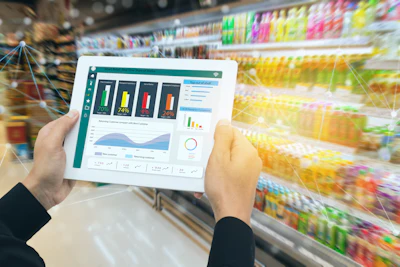
Real-time stock tracking addresses this challenge by continuously reconciling expected inventory positions with live store activity. By integrating receiving data, stock movements, and point-of-sale transactions, retailers gain dynamic visibility into where inventory is, how it is moving, and whether it is at risk of not being available to sell. This visibility can also extend to time-sensitive attributes such as expiration risk, enabling stores to act before product becomes waste rather than after margin has been lost.
When analyzed dynamically, these signals reveal recurring patterns that static reporting often obscures. Certain categories may consistently generate phantom inventory. Specific SKUs may repeatedly fall out of stock despite appearing available in the system. Particular operational processes may create recurring discrepancies. The value lies in acting on these insights before revenue is lost. Given ongoing labor constraints, it is unrealistic to expect associates to manually verify every aisle. Real-time tracking enables an exception-based operating model in which store teams focus attention where availability risk and commercial impact are highest. District and regional leaders gain clearer visibility into whether performance issues stem from upstream supply constraints or in-store execution gaps. Inventory visibility becomes continuous and actionable rather than retrospective.
Why it matters now
Inventory accuracy is often treated as a technical metric, but in practice it shapes multiple dimensions of performance. When stock records are unreliable, labor effort is misallocated. Associates spend time searching for items the system indicates are available. Replenishment activity may focus on products that are not genuinely at risk, while true availability gaps remain unresolved. In a labor-constrained environment, this inefficiency compounds quickly. At the same time, retail media performance depends on promoted items being consistently available, and advanced forecasting and automation depend on accurate stock data. Optimization built on inaccurate inventory simply scales inefficiency.
In today’s grocery market, shopper experience is defined by reliability. Customers expect alignment between what they see online, what the system reports, and what is physically present on the shelf. Retail Insight’s research indicates that 26% of shoppers would abandon a trip after encountering shelf gaps, and 35% would reconsider loyalty if availability problems became frequent. Real-time stock visibility reduces the gap between digital promise and physical reality, strengthening trust and protecting long-term customer relationships.
As grocery retailers continue investing in automation and advanced analytics, the integrity and timeliness of inventory data become increasingly critical because planning sophistication cannot compensate for limited execution visibility at the shelf. Real-time stock tracking provides the control layer that reconciles system belief with physical stock position, strengthening store execution, protecting revenue, reducing waste, and improving labor productivity. For retailers seeking sustainable margin improvement, accurate inventory visibility inside the store is no longer optional. Without it, even the most sophisticated planning systems struggle to translate plans into commercially resilient execution at the shelf.