
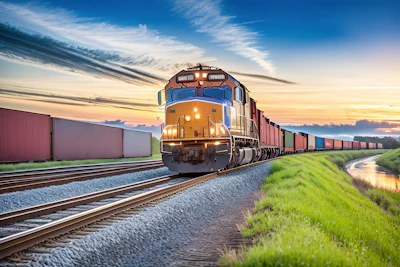
A refrigerated railcar is somewhere in transit. It is carrying temperature-sensitive ingredients that a processing facility is counting on. The delivery window is closing. And the team is not completely clear on where that car is, what condition it is in, or whether it is going to arrive in time because that data lives in fragmented systems.
This lack of clarity can get costly quickly.
That gap between what a shipper expects and what is actually unfolding on the rail network is not a planning inconvenience. It is a cost event waiting to happen. The problem is rarely a lack of discipline. These are teams that care deeply about performance. The challenge is that they have historically been asked to make high-stakes decisions with incomplete or delayed information. The companies moving fastest to close that gap are the ones gaining a measurable edge.
At one food manufacturing operation, for example, the team began comparing original estimated arrival times (OETA) with current ETAs for inbound rail shipments serving a key processing facility. The flagged shipments deviating from the original schedule and projected arrival as shipments progressed through the network.
Comparing those updated ETAs against facility need-by times allowed the team to identify potential supply risks much earlier. Shipments that appeared to be on schedule based on their original ETA were, in reality, trending toward a late arrival that could impact production. By monitoring the delta between current ETA and the facility's need-by time, the team gained the lead time needed to adjust operations, avoid production disruptions, and reduce reliance on expedited freight. Shippers can achieve measurable improvements in supply chain performance when they have the right data, at the right time, without having to spend hours assembling data streams to get a clear picture of their rail operations.
The stakes are higher for food and beverage
Rail is the backbone of the food and beverage supply chain, moving corn, grain, oils, and other bulk ingredients from origin points to processing facilities across North America. At scale, it offers lower per-unit costs than trucking and is often the most efficient mode available. But the tolerance for disruption is narrow in a way that does not apply to most other commodities.
A delayed ingredient shipment does not create a fulfillment gap. It stops the line entirely. When a processing facility runs short on a critical input, production halts, commitments are missed, and emergency freight costs follow. A single line stoppage can reach into the tens of thousands of dollars within hours.
For refrigerated shipments, the exposure is more acute. Reefer containers require continuous monitoring throughout their journey. Fuel levels, temperature integrity, and dwell time are not just operational metrics. They are the difference between product that arrives usable and product that does not. A reefer sitting idle two days longer than anticipated is a potential spoilage event, a customer service failure, and a material financial loss arriving all at once.
One ocean carrier put that visibility to work. Moving thousands of containers on rail each month, it significantly reduced commodity spoilage due to reefer timeouts by segmenting refrigerated shipments in its reporting and setting alerts for increasing dwell time. The issue was not the absence of data, but the lack of timely insight to guide intervention.
The expectation gap is real and growing
With “Amazonization” came a generation of logistics managers that grew up tracking packages in real time as a baseline expectation. That standard is now being applied to rail. If users can watch a consumer shipment move across the country on their phone, then they should be able to track a railcar carrying a million dollars worth of ingredients with at least the same granularity. That is not an unreasonable demand. It reflects what is technically possible and what the people accountable for these supply chains are being asked to deliver.
The rail network generates substantial operational data including movement events, equipment health signals, dwell patterns, and more. The challenge has never been a shortage of raw information. It has been consolidating and contextualizing it in a form that is actionable in time to change outcomes. That gap between data that exists and intelligence that is usable is where most of the unrecovered cost currently lives.
Visibility is the floor, not the ceiling
The most operationally mature food and beverage shippers understand that visibility is just the starting point. Knowing where a car is matters. Knowing what it is likely to do next is what drives better decisions.
Demurrage is a clear example. Charges accrue because teams did not have early enough warning that a car was at risk or did not have event-level data to challenge a billing error with confidence. Genuinely controlling demurrage requires anticipating exposure before it accrues and being able to dispute charges with documentation that holds up. Equipment health follows the same logic. There are usually several signals that a car needs maintenance before it becomes an immediate requirement. Shippers who identify the signals early have options. Shippers don’t want to discover a railcar is ordered after it's already loaded and en route. At that point, they have only one option, and it's an expensive one.
The path forward is proactive by design
The most resilient food and beverage supply chains are not waiting for problems to surface. They are building the capability to anticipate them. That shift from reactive to predictive operations requires three things working together. The first is comprehensive, timely access to network data. The second is the analytical capability to surface the signals that matter. The third, and most often the missing piece, is the operational expertise to know what those signals mean and how to act on them.
Data fluency and rail operations knowledge are not the same skill set, and most internal teams are strong in one area but not both. The value of working with partners who bring experience in both is concrete. It is the difference between data that informs and data that sits unused, between charges that are recovered and charges that are simply paid. It is also the difference between a team spending its energy interpreting raw data and a team spending its energy making decisions. In a sector where margins are tight and the cost of a missed window compounds fast, that distinction matters more than most people realize until they have experienced it firsthand.
The shippers navigating today's environment are operating under more cost pressure and higher service expectations than at any point in recent memory. The tools to meet those demands are available. The question is how quickly the industry moves to put them to work.






![Top Tech Logo 2026 Vertical [color]](https://img.foodlogistics.com/mindful/acbm/workspaces/default/uploads/2026/04/top-tech-logo-2026-vertical-color.mWl7RAiZmg.png?ar=16%3A9&auto=format%2Ccompress&bg=fff&dpr=2&fill-color=fff&fit=fill&h=135&q=70&w=240)


