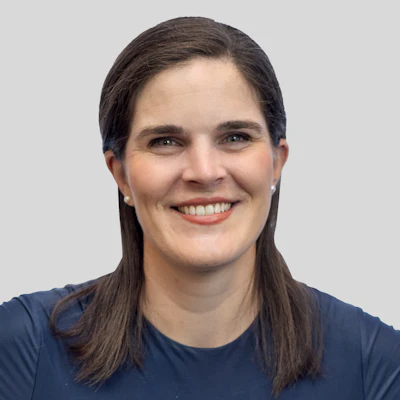
Kary Jablonski has experienced two phases of her career: one at Trucker Tools before its acquisition by DAT, and another as a leader at DAT following the acquisition.
However, her journey didn’t start in trucking or technology. Post-college, it was her management job at Uber that first introduced her to logistics and freight technology, where she became interested in marketplaces, how to move product from Point A to Point B, and the challenges involved.
Enter her time as CEO of Trucker Tools, where she originally joined as COO, stepping into a small, founder-led, bootstrapped business with an ambitious but unfocused product roadmap. In a short time, she refocused Trucker Tools on load visibility and tracking for freight brokers. She made tough strategic decisions, retired legacy products and rallied teams around a mission to help brokers capitalize on the location technology available in every truck.
Currently, she serves as EVP, broker segment, trucker tools and marketing at DAT Freight & Analytics, responsible for the DAT One load board, Trucker Tools visibility service, and Carrier Management Suite. Since joining DAT, she’s also played an integral role in DAT acquiring Outgo, a freight factoring and financial services platform, and the Convoy Platform from Flexport, which automates transactions on the spot market.
Heading into 2026, her priorities center around unifying DAT’s broker products, integrating the DAT One marketplace, Trucker Tools visibility, and Carrier Management Suite into a seamless, end-to-end operating platform. She’s looking to scale Carrier Management Suite to give brokers more protection against fraud, safety risks, and compliance issues. She wants to help brokers improve their service levels through accurate visibility, better ETA predictability, and tools. And, Jablonski is looking to elevate her voice in the industry to inspire the next wave of leadership in freight tech.
Jablonski sits down with Marina Mayer, editor-in-chief of Food Logistics and Supply & Demand Chain Executive and co-founder of the Women in Supply Chain Forum, to talk trends, challenges and opportunities impacting brokers in 2026.
Food Logistics: Let’s first talk about you. Tell me a little bit about yourself and your journey to get to this current stage in your career?
Kary Jablonski: I didn’t grow up in a trucking family, and I definitely didn’t plan on a job in freight. My career has been less about following a defined path and more about wanting to work on interesting problems. Early in my career, I worked at Uber—not Uber Freight, which was just starting at the time, but on the ride-sharing side and later Uber Eats. That’s where I got hooked on logistics and marketplaces. I loved the challenge of making the physical world work more efficiently with technology, and Uber was doing some fascinating things during its hyper-scale phase.
I went to business school and then joined Alpine Investors, a private equity firm with a great CEO-in-Training program that places recent grads in management positions at their portfolio companies. This is what led me to Trucker Tools in 2021.
I joined as COO, and at the time, there was a lot going on. In a macro sense, it was post-pandemic, an extraordinarily chaotic time for freight. At the business, we had a mobile app with 17 different tools for truck drivers, plus a broker/3PL visibility and capacity platform, and a host of other projects on the go.
Our founders were still on board, and I was fortunate to have them as a resource but also the autonomy to make decisions about our way forward. At its core, Trucker Tools had all the characteristics that drew me to Uber: a marketplace, a strong mobile component, and a mission to solve complex problems like bringing load visibility to brokers. We really focused on delivering what customers wanted at a very high but accessible level, and today DAT gives Trucker Tools the resources to bring that work to scale.
Food Logistics: Fun fact about you, you previously served as CEO of Trucker Tools, which was acquired by DAT Freight & Analytics in December 2024. And, since the Trucker Tools acquisition, you’ve played an important role in two other acquisitions: Outgo and the Convoy Platform. What’s your secret to success?
Jablonski: I don’t know if there’s a secret, but I can tell you what I’ve learned.
You have to be obsessed with understanding your customer. A lot of startups fail because they fall in love with their own technology without truly understanding the people they’re serving. You don’t need prior industry experience to succeed in freight tech, but you do need to get out of the office, meet people where they work, and listen deeply to what drives their success.
The other thing is focus. When I joined Trucker Tools, we were doing too many things. Like many startups with a lot of organic growth, we were very responsive to customer asks—probably too responsive. We had to make tough choices. We streamlined around visibility and tracking for freight brokers, and that clarity became the foundation for our growth.
With the DAT acquisitions—Trucker Tools, Outgo, and Convoy Platform—the work now is about integration and alignment, which requires customer obsession and focus every day.
Food Logistics: When it comes to brokers in 2026, what are you seeing as some of the biggest trends and/or challenges?
Jablonski: It’s weird to say, given how consistently flat the truckload freight market has been since early 2022, but the biggest challenge for brokers is uncertainty. They’re trying to balance serving customers with managing risk in their own business, whether that’s fraud, access to capacity, or simply making sure a load shows up on time. Legal decisions on broker liability and tariffs could also make for a chaotic year.
On the tech side, brokers are increasingly comfortable with AI and automation to save time and costs. Most use some type of product or service to automate workflows, document processing, communication, pricing, and payments. But they need tools that work together. A lot of freight tech has been built in silos, and brokers are tired of toggling among platforms. They want an integrated workflow and the choice to automate when they want to. That’s what we’re building at DAT.
Food Logistics: One of the goals outlined in your application is to scale the Carrier Management Suite to give brokers more protection against fraud, safety risks, and compliance issues. Why is this so important?
Jablonski: You have to know and trust your partners. Double brokering, identity theft, cargo theft—they’re happening at scale and costing brokers and shippers millions. On top of that, brokers are under pressure to vet carriers for safety and compliance quickly.
Carrier Management Suite flips that workflow. Instead of checking carriers after the fact, brokers on our DAT One load board can automatically enforce qualification rules before a carrier even sees a load. They control who sees what without leaving DAT One. It moves carrier vetting upstream, where it should be.
Food Logistics: The Top Transportation Professional recognizes professionals in the transportation space. What advice do you have for other transportation professionals or even those looking to join the transportation space?
Jablonski: I learned the hard way that nothing is certain. Early in my career at Uber, I relocated to Jakarta for a temporary assignment. On my first day, Uber announced it was selling its Southeast Asian operations and shutting down the office. I was 10,000 miles from home, and it was one of the most emotional experiences of my career. You can never hang your hat on a specific set of circumstances, and some things are out of your control. So keep your head clear and be ready to pivot.
I’d also say stay curious and close to your customers. Freight is a people-driven industry, no matter how much we talk about automation and technology. The one-truck owner-operator, the freight brokerage owner, the big global shipper—they’re all interesting, creative, entrepreneurial, problem solvers. If you’re not getting out of the office and listening to the people you’re serving, you’re missing opportunities professionally and personally.
Food Logistics: What are some things not addressed above that would be pertinent to include in the article detailing your strengths, achievements, overall goals, etc.?
Jablonski: One thing I haven’t talked much about is how much of my leadership philosophy comes from spending nine summers at an all-girls camp in Maine.
I grew up with two brothers who ran the show at home, so I wasn’t a naturally outgoing kid. But camp changed that. For seven weeks each summer, we lived in cabins with zero electricity. Campers ranged in age from 7-15 and came from all over to this idyllic summer camp setting, on a big lake, completely removed from our day-to-day lives.
Being in an all-girls environment all summer was incredibly nurturing. I learned how to live and work in a group—you can’t just tell people what to do at camp. You have to build relationships, listen, collaborate, and inspire people to work toward something bigger than themselves.
Those summers taught me to speak up, hold my own, and eventually lead without relying on authority or hierarchy. They showed me that leadership isn’t about being the loudest voice in the room. It’s about making people feel seen and valued, especially in challenging moments.
Lessons from camp have carried me through every stage of my career, from managing teams at Uber to leading Trucker Tools and now the broker business at DAT. Those seven-week sessions every summer gave me a foundation in authentic leadership I didn’t even realize I was building at the time.