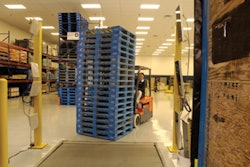
The largest and most widely-supported industry field test of RFID technology on reusable transport packaging is under way, according to the Reusable Pallet & Container Coalition (RPCC), Washington.
The study is supported by a group of RPCC members and industry leaders that represent every facet of the supply chain. The participants include Wal-Mart, Frontera, The Kennedy Group, Avery Dennison, Alien, UPM Raflatac, Impinj, IFCO Systems, Georgia-Pacific and ORBIS.
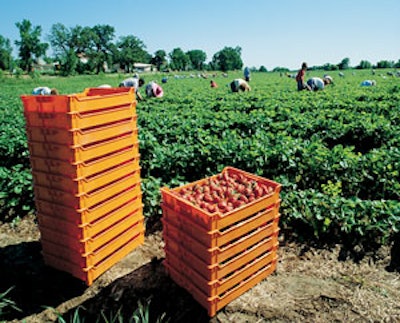
Currently, thousands of reusable containers with affixed RFID tags are being tested throughout the supply chain, from the wet and cold conditions of grower fields, to the rugged and repeated handling of distribution centers and on to the retail environment. This large scale field trial comes on the heels of rigorous laboratory testing at Michigan State University School of Packaging.
"There has never been an RFID-related field trial of this magnitude in the United States with so many key supply chain partners," says Fred Heptinstall of IFCO Systems and RPCC president. "If the field trial results mirror the data from the laboratory testing, we will prove unequivocally that reusables are the enabler to the cost-effective use of RFID technology."
During the laboratory trial, 230 reusable containers with nine different EPC-compliant, Gen 2 RFID tags were vigorously tested at Michigan State University School of Packaging.
Readability tests were conducted by a CalPoly scientist at a second laboratory and results were verified by third-party advisors. The project team performed more than 160 hours of testing and more than 14,000 tests.
The containers were subjected to sinusoidal vibration and drop tests on all edges as well as repeated cleaning and handling. In addition to proving durability, the data demonstrated that it is possible to get 100 percent read rates 100 percent of the time which has never been achieved in the industry before. The three tags that performed optimally during the testing are currently being used in the field trial.
"The durability and readability of the RFID tags during the lab tests were superb," says Pat Kennedy of The Kennedy Group and the RPCC project leader. "The information gathered from these studies will help businesses make data-driven decisions about the cost effectiveness and feasibility of incorporating reusable containers into their supply chains from an enhanced track and trace perspective."
In the field trial that is currently under way, the reusable containers with the multi-cycle RFID tags are being used in grower fields in Washington and California where they are being subjected to mud, varying weather conditions and rough handling in the field. From there, produce in the containers is shipped to Wal-Mart distribution centers, where the produce is cleaned and the containers and tags are subject to washing, further handling, refrigeration and storage before being sent to retail stores.
Eventually, the containers are collapsed and sent back through the supply chain for further cleaning, handling and storage. Each container is going through a minimum of three cycles of use. At the end of each cycle, the RFID tags are being tested for viability, then re-encoded for the next cycle. The six-month field trial is expected to end in spring 2008.
Because perishables are shipped under the most demanding conditions, a successful field test with perishables will provide convincing evidence of the feasibility of using RFID technology with reusable transport packaging in a wide-range of other industries, including automotive, beverage, pharmaceutical and others.
The adoption of RFID tags in the reusable supply chain has the potential to:
- Enhance supply chain visibility;
- Significantly reduce errors;
- Significantly reduce costs;
- Improve operational control of assets;
- Provide real time product and asset locations in the supply chain;
- Lead to significant changes in food traceability opportunities;
- Reduce container loss; and
- Generate a positive ROI on the cost of reusable containers.
Upon completion of the field trial, the RPCC will develop an economic model for integrating RFID tags with reusable transport packaging. Quality Logistics Management (QLM), an EPC global-certified Solutions Provider, will collect and analyze the data and present an industry white paper with the results.