When it comes to private label, food retailers in Europe are at the top of their game. While private label sales have been growing in the U.S. in recent years—and have been further boosted by the recession—European private label products are as popular as branded goods over there—sometimes outpacing the brand names in sales.
And unlike the U.S., where few retailers operate their own plants or have limited manufacturing capabilities, many European retailers have capitalized on the trend by operating their own manufacturing plants and producing their own private label brands.
EDEKA Group is one such company. The largest cooperative food retailer in Germany, EDEKA supplies some 1,500 private label items to more than 10,000 stores, producing everything from bakery and dairy products, to canned and frozen vegetables, to snacks and organic items, selling these products under a variety of private labels.
The company’s line of packaged and unpackaged meat and processed meats, comprised of sausage and beef and pork products, is one of its most successful lines. It manufactures about 60 percent of the sausages and 80 percent of the meat product its sells. EDEKA started processing its own meat in 1990 and today operates three meat processing facilities, the largest of which is the Bauerngut plant in Buckeburg, a town in northern Germany located about 40 miles west of Hannover.
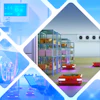
The 31,000-square-foot facility was rebuilt last year after it was partially destroyed by a fire in 2008. It features a fully-automated material handling system from SSI Schaefer and a logistics software system, called WAMAS, which monitors and controls the entire process from the goods receipt to transport to sale—ensuring the highest quality of meat while adhering to strict safety standards.
“Meat is a fragile product and we don’t want to leave anything to chance,” says Christoph Rösener, the head of Bauerngut’s information technology department. “Our system enables us to turn around customer orders in less than 24 hours—if they place an order today, we’ll have it to them no later than noon tomorrow.”
While the automation of the facility enables the company to be so responsive, EDEKA acts locally—all of its livestock comes from Germany and the farms and the slaughterhouses are located close to the plants. The short routes help to reduce stress for the animals while keeping transportation costs down and ensures that customers are getting the freshest product possible. The retailer only works with farmers that comply with strict animal welfare rules and prohibit the feeding of antibiotics.
“We don’t do the slaughtering here—we do the processing and packaging and then deliver to the stores,” says Rösener, adding that the Bauerngut plant produces a number of different private label brands for its retail stores, as well as its independent customers.
Every day, the plant supplies approximately 180 tons of portioned fresh meat and 120 tons of processed meat products to local retailers as well as to wholesalers across Germany—a performance that would be unimaginable without automation.
WAMAS Keeps It Humming
The Bauerngut plant is not a traditional warehouse—it’s a high-performance picking machine that was designed by SSI Schaefer Dortmund. Schaefer planned and executed the project, and implemented the material flow, control and picking systems, as well as WAMAS, Schaefer’s proprietary logistics software. Schaefer also provided training for the employees.
When Bauerngut installed the system in 2006, it wanted to reduce costs and stock outs and improve picking accuracy. The diverse picking processes were inefficient, so the company decided to unify the process under the “goods-to-man” principal, a concept developed by Schaefer.
The high-bay warehouse provides 40,000 storage locations for containers, boxes and cardboard, and is administered by stacker cranes at an ambient temperature of 30 to 32 degrees Fahrenheit. The automated system includes several goods-in gates, two storage and retrieval levels, 16 stacker cranes with dual load handling devices, eight goods-to-man picking points, two sorting levels to determine the final sequence of the containers and four palletizing robots at the outbound area.
Every day, some 30,000 containers are processed and picked and shipped to 1,500 retail customers.
“This performance is achieved by the high level of automation of the system and the perfect interplay between WAMAS and the warehouse and picking technology,” says Uwe Dörmann, the project manager who runs the operation.
WAMAS is really the brains of the operation, guiding, controlling and optimizing the automation. The software is comprised of modules for warehouse management and processes, order picking methods, material flow systems and track and trace.
The day begins with the morning deliveries of fresh product from the local slaughterhouses. The inbound goods are registered at 12 collection points, four collection lines with automated dispensing robots and eight manual transfer points and are subsequently transported on conveyors into the high-bay warehouse. The goods registration and stock addition are performed by WAMAS.
The items are transferred to the storage lines by pallets. Depalletizing robots adapted for this task perform the fully automated stacking and unstacking of goods. Sixteen stacker cranes are used to connect the 40,000 storage locations with the conveying systems around the clock. WAMAS continually optimizes all processes, guiding their performance.
A dynamic batch picking system ensures an ideal goods-to-man workflow at the eight picking locations. A stacker crane automatically provides the required source containers in the correct sequence.
A put-to-light system helps employees perform error-free picking by indicating where the goods belong. If too many or insufficient items end up in the target container, a weight check automatically identifies the picking error. The source containers, as well as the picked customer containers, return to the warehouse, where they are buffered until they are palletized or loaded. Both automated and manually picking are fully integrated in WAMAS.
Mobile terminals turn each stacker workstation into a complete picking location within the overall system. The arrival of goods is performed on the arrival of AGVs just-in-time and just-in-sequence. WAMAS controls a complex sorting mechanism within the outbound loading area. This includes the so-called “sortierharfen,” a sorting device developed by Schaefer which makes sure the right containers are available at the right time in the right sequence.
Four robots assume the task of fully automated palletizing. Once they have been packed and wrapped Bauerngut ships the packages to their destination, about 3,200 containers an hour.
“The picking performance is extraordinary,” says Dörmann. “The requirement for the high performance in the tight time frame that all the processes have to go through.”
The new picking strategy has enabled deliveries to be ready within 24 hours. “Just 25 percent of orders coming in are manually processed—the rest are handled by the automated system,” says Dörmann.