The Future of Food Logistics

Smartphones, demand planning and better use of POS information are some of the developments that will have a more profound effect in the year ahead.


“A retailer who has put the customer at the center of the enterprise will be poised to capitalize on that differentiator while it lasts, and protect themselves from the disadvantages of not having an omni-channel strategy later on. In a customer-centric world, sales become an outcome of meeting customer needs. That’s a very different way of approaching the business than grocers have historically considered,” Baird points out.

Software and technology providers are responding. In November, Aldata, a retail and distribution optimization firm, released its Omni-Shopper Suite. The company’s chief marketing officer, Allan Davies, says, “By providing a single view of all shopper behavior in one solution set, the Aldata Omni-Shopper Suite provides retailers and fast-moving consumer goods manufacturers with unique opportunities to better understand, promote and fulfill their shoppers’ needs, and meet changing expectations in real time.”


POS and demand planning

From his perspective, Tim Pyne, vice president of business development at Tompkins International, believes that demand planning will finally start to make substantial progress in the grocery sector.

Del Monte Foods has chalked up a lot of success with its implementation of One Network Enterprises’ demand-driven supply chain solution, which is offered in the cloud, he notes. Point of sale (POS) information from Del Monte’s grocery retailers is shared in real time across the entire supply chain “to the merchandising and replenishment teams, to the suppliers, and right up to the growers, in Del Monte’s case. This has resulted in a 20 to 30 percent reduction in inventory levels and huge improvements on the in-stock in stores,” explains Pyne.

Welch Foods’ Dee Biggs concurs. “POS is clearly the best demand signal available to manufacturers to plan their business.” Considering that consumers’ biggest gripe is when a store is out of stock on an item, this translates into a “huge opportunity” for the grocery sector, he adds.

Indeed, Pyne estimates that only about one quarter of the grocery sector is currently using demand planning to get full visibility of the supply chain, so there’s definitely a lot of growth potential.


Goals for the grocer

Peter Mehring, CEO of Intelleflex, says two major goals are influencing the food logistics sector, particularly on the grocers’ side. They are guaranteed shelf life for perishables, and certified, expert grocers for produce, proteins and seafood.

Given that perishables comprise roughly 41 percent of retail grocers’ revenue and are the majority of margin contribution, there is a lot of emphasis on perishables as a competitive differentiator, explains Mehring. Therefore, “Guaranteed shelf life will tell you that they are delivering high quality products.”

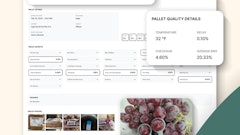
However, to support guaranteed shelf life, the food logistics sector “must move away from relying on visual inspection as the sole means to evaluate remaining freshness,” he says. Instead, “There has to be a migration to ‘measured freshness,’ which is based on a combination of condition monitoring data on a per pallet basis, and past statistics for similar product.” This requires measuring freshness from farm-to-shelf, and then matching distribution times with actual remaining freshness, a concept called “intelligent routing,” says Mehring.

While it’s possible to achieve this level of monitoring today, it’s still relatively new to most supply chain managers, he says, even though the upsides are tremendous. “The efficiency gains will benefit both the growers and food processors as well as the retailers because the data will significantly reduce the ‘surprise’ spoilage seen in current supply chains. The customer wins with more reliably fresh produce; the retailer wins with both more differentiated, high margin product and reduced internal waste; and the growers and food processors win because there is a higher yield being sold, which means greater revenue.”

On a related note, Mehring talks about the role grocers play in food safety. Although consumers can use their smartphones to scan QR codes for information on when something was picked or what ingredients it contains, the reality is that most are too busy to do it. “I believe we just want to trust our grocer,” offers Mehring, “just like we trust a doctor or auto mechanic or any other professional that provides a service and hides the complexity from us.”